MUC16 as a Therapeutic Target: Advancing Antibody-Drug Conjugates for Ovarian Cancer Treatment
SGO 2026
David O’Malley, Michael Birrer, Ursula Matulonis, Kathleen Moore, Fernanda Musa, Maria Rubinstein, Ritu Salani, Dayana Delgado, Lennart Langouche, David Dornan, Kathleen Keegan, David Lennon, Ashwini Pai, Robert Coleman
Objectives
Treatment options are limited and prognosis is poor for patients with platinum-refractory/resistant ovarian cancer (PROC). Antibody-drug conjugates (ADCs) represent a promising therapeutic strategy, with treatments in development directed to several targets including MUC16, MSLN, NaPi2b, FRα, HER2, CDH6, B7-H4, Trop-2, Nectin-4, and CLDN6. MUC16 is a promising target due to its high expression in ovarian tumors versus normal ovarian tissue and its role in disease progression. Data from public databases demonstrate that MUC16 RNA expression is correlated with protein expression. This study investigates MUC16 RNA expression across histologic subtypes and in PROC vs platinum-sensitive ovarian cancer (PSOC); and compares this expression with that of other therapeutic targets in development.
Methods
RNA sequencing data (Tempus AI, Inc.) were employed to explore gene expression across ovarian cancer histologic subtypes and between PROC vs PSOC. Median gene expression was reported as log₂(transcripts per million [TPM]+1), with group differences analyzed using the Kruskal-Wallis test and co-expression with other ADC targets assessed using Spearman’s correlation (ρ).
Results
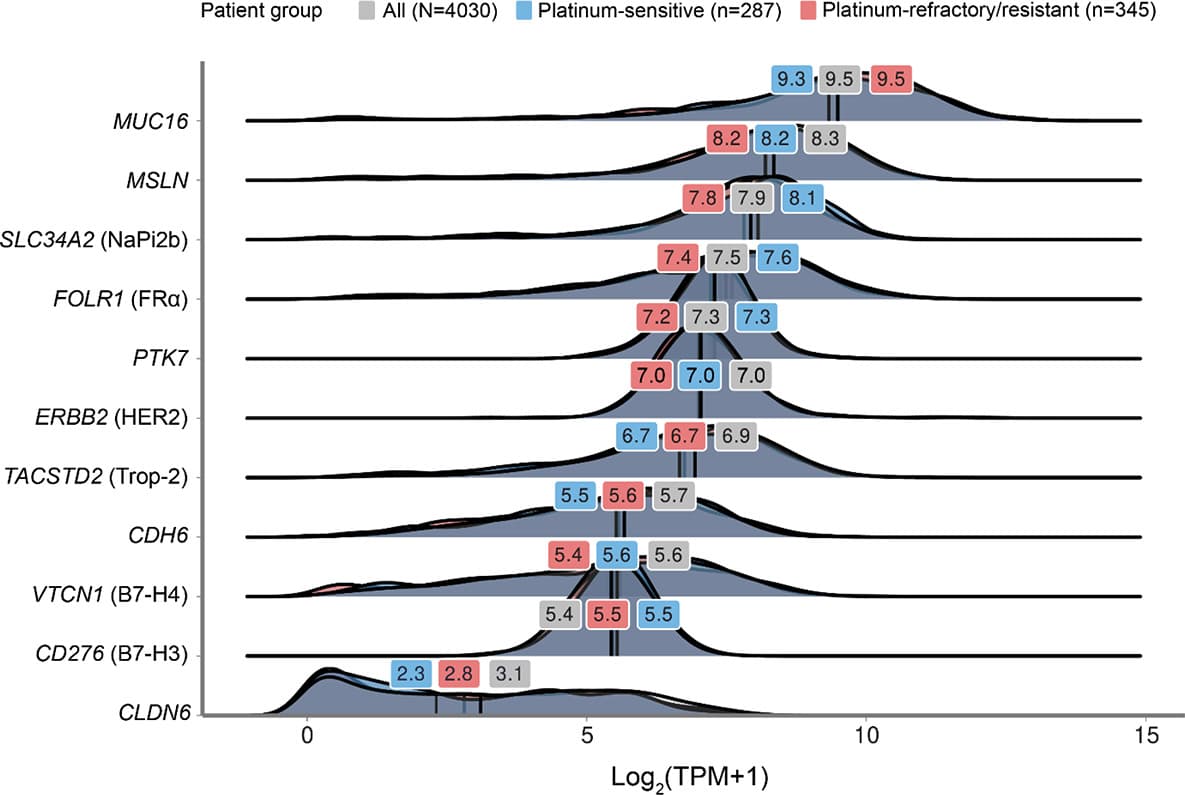
Gene expression was analyzed in tumors from 7244 patients, comprising nine histologic subtypes of ovarian cancer. Of all tested biomarkers, MUC16 showed the highest median expression—with log₂(TPM+1) of 9.1—which represents 3- to more than 100-fold higher median expression than genes encoding the other biomarkers (MSLN, 3-fold; NaPi2b, 3-fold; FRα, 6-fold; HER2, 5-fold; CDH6, 20-fold; B7-H4, 14.9-fold; Trop-2, 6-fold; Nectin-4, 32-fold; CLDN6, 128-fold). In ovarian high-grade serous carcinoma (n = 4030), median MUC16 expression was high in both PROC (9.5) and PSOC (9.3) and remained higher than expression levels of all other biomarkers when stratified by platinum-sensitivity status (Figure). Specifically, in PROC, MUC16 expression was 3- to 104-fold higher than that of genes encoding MSLN (3-fold); NaPi2b (3-fold); FRα (4-fold); HER2 (6-fold); CDH6 (15-fold); B7-H4 (17-fold); Trop-2 (7-fold); Nectin-4 (39-fold); and CLDN6 (104-fold). Similarly in PSOC, MUC16 expression was 2- to 128-fold higher than that of genes encoding MSLN (2-fold); NaPi2b (2-fold); FRα (3-fold); HER2 (5-fold); CDH6 (14-fold); B7-H4 (13-fold); Trop-2 (6-fold); Nectin-4 (37-fold); and CLDN6 (128-fold). MUC16 expression was weakly correlated with expression of FRα (ρ = 0.23), HER2 (ρ = 0.13), B7-H4 (ρ = 0.29), and CDH6 (ρ = 0.23).
Conclusions
MUC16 expression levels are substantially higher — irrespective of platinum sensitivity — than those of genes encoding other ADC targets in development for ovarian cancer. Weak correlations between MUC16 and FRα, HER2, B7-H4, and CDH6 mRNA expression suggest that MUC16 defines an independent population that may benefit from MUC16-targeted therapy due to uniquely high MUC16 expression. These data support MUC16 as an attractive target for the treatment of ovarian cancer.