-
PROVIDERS
Learn more
Join Tempus at the 2026 ASCO® Annual Meeting!
-
LIFE SCIENCES
REGISTER NOW
From insight to impact: Leveraging the AI-enabled Next platform with BMS to advance equitable access in precision oncology
-
PATIENTS
It's About Time
View the Tempus vision.
- RESOURCES
-
ABOUT US
View Job Postings
We’re looking for people who can change the world.
- INVESTORS
10/14/2025
Real-World Molecular Epidemiology Study of Select Biomarkers in Extensive-Stage Small-Cell Lung Cancer (ES-SCLC)
ESMO 2025
Abstract
Authors
C.M. Rudin, C.M. Gay, N. Choudhury, A.C. Chiang, H. Hu, J. Ma, C. Chen, R. Cristescu, E.J. Dettman, K. Zu, J.E. Gray
Background – Small prospective analyses have shown patients (pts) with select biomarkers or distinct ES-SCLC transcriptional subtypes may have distinct clinical outcomes. To investigate the potential prognostic value of these factors, we evaluated the association between SCLC subtypes and select biomarkers with clinical outcomes in pts with ES-SCLC.
Methods – Based on real-world (rw), deidentified patient-level data from the Tempus database (Tempus AI, Inc., Chicago, IL), this retrospective cohort study identified adult pts diagnosed with ES-SCLC from 2018 to 2022 who started first-line systemic therapy containing any immune checkpoint inhibitor, and had available tumor RNA (Tempus xR) and DNA (Tempus xT) sequencing data. Baseline characteristics at start of first-line therapy (ie, index date for survival analyses) and T-cell inflamed gene expression profile (TcellinfGEP) were descriptively analyzed by subtype based on transcription factor expression: neuroendocrine (NE) subtypes SCLC-A (high ASCL1) and SCLC-N (high NEUROD1), and non-NE subtypes SCLC-P (high POU2F3) and triple negative (TN). Associations between subtypes and TcellinfGEP with rwPFS and rwOS were assessed using risk set-adjusted Cox regression models. Database cutoff: 6/30/24.
Results – Among 298 pts, 157 (52.7%) were female, median age was 66.3 (range, 22.4‒85.8) y, and median follow-up was 11.8 (range, 0.1–62.1) mo. High TcellinfGEP was associated with longer rwPFS (HR = 0.54; 95% CI, 0.35–0.82) and rwOS (HR = 0.58; 95% CI, 0.42–0.80). TN and SCLC-P subtypes had higher TcellinfGEP; SCLC-P (vs SCLC-A) was associated with higher risk of progression (Table).
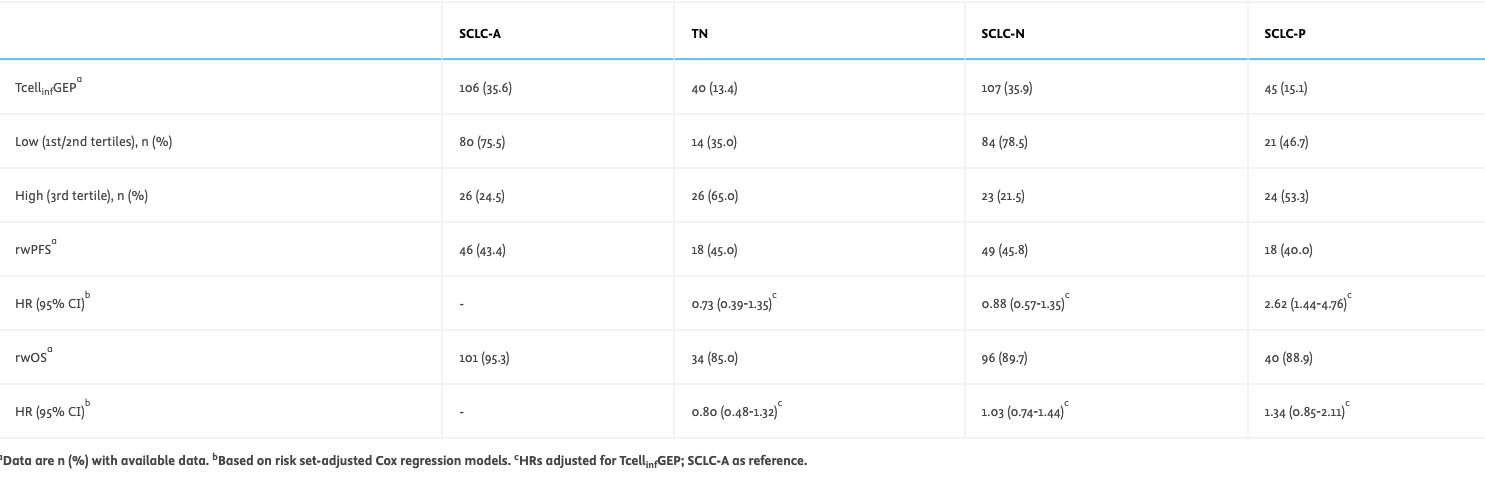
Conclusions – Non-NE subtypes, with higher TcellinfGEP, are more inflamed. With mutual adjustment, high TcellinfGEP was associated with reduced risk of progression or death, but among SCLC subtypes, only SCLC-P was associated with shorter rwPFS. These rw data compliment similar RNA-based biomarker findings from clinical trials.