-
PROVIDERS
REGISTER NOW
Upcoming Webinar:
MRD data insights across the cancer care continuum -
LIFE SCIENCES
Read now
Accelerating a phase 1 oncology trial: The TIME Network's impact on patient enrollment
-
PATIENTS
It's About Time
View the Tempus vision.
- RESOURCES
-
ABOUT US
View Job Postings
We’re looking for people who can change the world.
- INVESTORS
01/14/2026
Q&A: How real-world data drives value and de-risks development
In a recent webinar hosted by Tempus, leaders from the biotech and investment sectors gathered to discuss how real-world data is used to de-risk development, build investor confidence, and drive value in a challenging market.
Authors
Andy Moye
SVP & GM, Data Products, Tempus

Matthew Price
Co-Founder & COO, Director, Promontory

Nick Glover, PhD
CEO, MycRx

Brad Hirsch, MD
Co-Founder, Highlander Health

SVP & GM, Data Products, Tempus
Matthew Price
Co-Founder & COO, Director, Promontory
Nick Glover, PhD
CEO, MycRx
Brad Hirsch, MD
Co-Founder, Highlander Health
Andy Moye, PhD, SVP and General Manager of Data Products at Tempus, was joined by Matthew Price, Co-founder and Chief Operating Officer at Promontory Therapeutics, Nick Glover, PhD, CEO of MycRx, and Brad Hirsch, MD, Co-founder of Highlander Health. Their conversation explored how RWD helps bridge the gap from preclinical research to clinical validation, addresses evolving regulatory demands, and provides the evidence needed to build confidence with investors and partners.
|
“RWD provides a solution by allowing us to find real-world patients to benchmark outcomes and build a credible, de-risked story for our registrational trial design.” – Matthew Price, Co-founder and Chief Operating Officer at Promontory Therapeutics |
Andy Moye, PhD: In today’s challenging economic climate, how are biotech leaders navigating the funding landscape, and what is the general sentiment? |
Matthew Price: My personal view is that we have been in a perfect storm. After a wave of interest during the pandemic, the sector faced surging interest rates and significant regulatory uncertainty. While sentiment is improving, we must be guarded. I view it with cautious optimism, but the reality is that biotech leaders must find ways to counteract these larger forces. The question becomes: are there tools we can use during the development process to create value and de-risk our programs in this environment?
Nick Glover, PhD: I agree, we are all feeling more optimistic, but the key question is which companies are attracting capital and why. There has been a real shift toward well-established targets, leaving those of us on the leading edge with novel mechanisms in a difficult position. It has become a “show-me situation.” You have to put compelling data on the table that gives investors a reason to believe. For a novel target, you have to convince people with evidence that you have achieved something and show them where you are taking it.Brad Hirsch, MD: The improving sentiment is the first sign, but it will take time for the reality to catch up in the market. New investors are the last to arrive. I have to be cautiously optimistic, like everyone else, that this is the natural order of things. The concern about regulatory uncertainty is very real, but so far, there are ways to navigate it. We have to bring the regulators along on the journey so they can understand new approaches and gain confidence in them. |
Andy Moye, PhD: How does RWD specifically help companies de-risk development and build the confidence that investors and partners are looking for? |
Nick Glover, PhD: For a novel mechanism, RWD has the potential to be catalytic. It provides a crucial bridge between the fundamental, mechanistic data we generate in the lab and the reality of actual patients. When you are breaking new ground and have no precedent to draw upon, you can either ask for a leap of faith or you can use data. RWD allows us to scale our research findings and project how a therapy might perform, bridging that gap before we even have clinical data and building a data-driven case for our strategy.
Matthew Price: RWD is also essential for navigating major regulatory changes, like the FDA’s Project Optimus, requiring dose optimization and the increasing demand for overall survival (OS) data. For a smaller company that cannot afford a large, randomized controlled Phase 2 trial, the question is how to benchmark the expected OS in your target patient population. The published literature is often outdated. RWD provides a solution by allowing us to find real-world patients to benchmark outcomes and build a credible, de-risked story for our registrational trial design. |
|
“[Utilizing Tempus’ multi-omics data] allowed us to strategically prioritize where to go first, building a sophisticated development plan that is grounded in real-world biology from the start.” –Nick Glover, PhD, CEO of MycRx |
Andy Moye, PhD: Can you share specific examples of how you have used Tempus’ RWD to make critical decisions? |
Matthew Price: In our program for metastatic castration-resistant prostate cancer, we took our Phase 3 criteria to Tempus to find a real-world comparator cohort. Within Tempus’ data, we found 139 recent patients treated with the comparator drug. This cohort showed a median OS of 7.9 to 10.6 months, which provided a powerful benchmark against our own Phase 2 data. This allowed us to validate our trial design, refine our statistical plan, and ultimately build a much more credible case for our path forward. It was a very important experience for us.
Nick Glover, PhD: Our use case was different. We are drugging MYC, which is a complex transcriptional regulator. It is not a single target; it is a systems biology question. We utilized Tempus’ multi-omics data to enhance our understanding of MYC transcriptional biology and hierarchically rank indications. The analysis was illuminating. It showed us sensitive cohorts in almost every cancer and allowed us to strategically prioritize where to go first, building a sophisticated development plan that is grounded in real-world biology from the start. |
Andy Moye, PhD: From an investor and regulatory perspective, what is the key to successfully using RWD and ensuring it is high quality? |
| Brad Hirsch, MD: The FDA is increasingly open to RWD, but you need patient-level data that is truly regulatory-grade. When evaluating a company’s use of RWD, you have to dig under the hood to understand the nuances of the data: how it was captured, how complete it is, and what the quality controls are. Many providers will give you an enormous patient count that turns out to be implausible. You have to work with the right folks who understand the data and can help you answer questions appropriately. When you marry high-quality data with the right analytical approach, you can make some really compelling arguments. |
Andy Moye, PhD: Finally, what advice would you give to other biotech leaders who are considering an investment in RWD and AI-enabled tools? |
Nick Glover, PhD: The truism in biotech is that good science wins out. For complex systems biology targets, there is no other way forward than using systems biology solutions like Multi-omics data and liquid biopsies. These are foundational and transformational technologies. They allow us to identify patients most likely to respond and then follow them in real-time. It should not be a leap of faith; it should be an informed, rational, and risk-adjusted development strategy.
Matthew Price: While AI is hot, the hard reality of clinical development is inescapable. We use these tools to get more out of the development process itself. The watchword of the last few years has been focus. These AI-enabled data curation tools allow you to focus in a productive way. We have been impressed with the speed at which you can generate insights, which can lead to faster timelines, more efficient use of capital, and potentially better outcomes.Brad Hirsch, MD: My advice is to ask if the AI or tech component fundamentally changes the business. Does it give you a proprietary data advantage? Does it change the economics of development by shortening timelines or improving patient selection? If it does, it is a true differentiator. If not, it may still be a fantastic company with a compelling mechanism, but we try to separate the hype from the real, tangible impact on business. |
Please note that the content in this document has been revised for clarity and conciseness. Some language and formatting may have been adjusted to enhance readability while preserving the original meaning and intent of the discussion.
| For more insights into Tempus’ role in helping drive value and de-risking development for biotechs, we invite you to watch the webinar recording. |
-
 04/03/2026
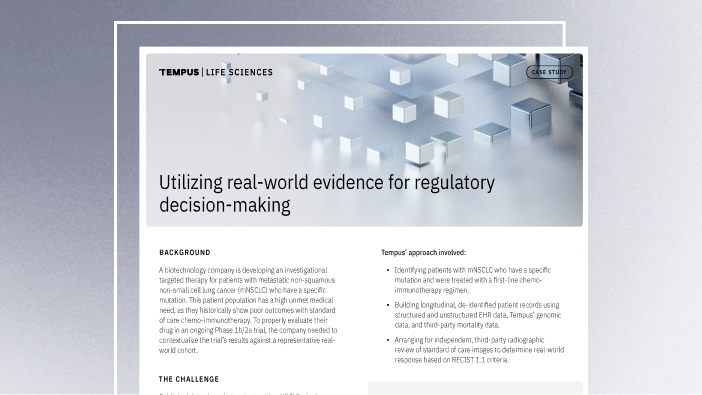
Utilizing real-world external controls for regulatory decision-making
A biotech company needed to contextualize its Phase 1b/2a trial for mNSCLC patients with a specific mutation. Learn how Tempus constructed a real-world external control arm to provide a benchmark for their regulatory submission.
Read more -
 03/24/2026
Translating data into an actionable R&D strategy
Hear from industry leaders about how a data-driven understanding of disease biology informs critical decisions and accelerates therapeutic development. Secure your recording now.
Watch replay -
 03/09/2026
From model to medicine: Closing the preclinical to clinical gap with an integrated, data-driven engine
Richard Klinghoffer, SVP and Head of Systems Biology at Tempus, discusses how preclinical models can be disconnected from real patient biology, contributing to challenges in oncology drug development.
Read more
Assess your cohort’s feasibility with our RWD
Submit your preliminary criteria, and our team will provide a tailored feasibility assessment to help accelerate your research goals.*