-
PROVIDERS
REGISTER NOW
Upcoming Webinar:
MRD data insights across the cancer care continuum -
LIFE SCIENCES
REGISTER NOW
From insight to impact: Leveraging the AI-enabled Next platform with BMS to advance equitable access in precision oncology
-
PATIENTS
It's About Time
View the Tempus vision.
- RESOURCES
-
ABOUT US
View Job Postings
We’re looking for people who can change the world.
- INVESTORS
01/04/2026
How AI is impacting electrocardiography and ECG interpretation for a more accurate diagnosis of cardiovascular diseases
Learn how Tempus’ AI-powered ECG Analysis Platform, developed with Geisinger, analyzes ECG data to predict mortality risk and identify patients at high risk for AFib-related stroke, even when ECGs appear normal.
Key Takeaways:
- Over 100 million 12-lead electrocardiograms (ECGs) are performed in the U.S. each year.
- Our initial 2020 study with Geisinger, published in Nature Medicine, demonstrated that AI can predict mortality directly from ECG data even in the large subset of ECGs interpreted by physicians as normal.
- Importantly, nearly two-thirds of patients without known AFib, who then experienced an AFib-related stroke, were identified as high risk by the model before the stroke occurred.
- In 2021, the FDA granted Breakthrough Device Designation to a new medical device: Tempus’ ECG Analysis Platform developed in collaboration with Geisinger.
Building the ECG of the future with Artificial Intelligence
Over 100 million 12-lead electrocardiograms (ECGs) are performed in the U.S. each year. The ECG is the most common diagnostic tool used to identify and combat heart disease, yet ECG interpretation frustratingly remains largely the same today as it has been for the last several decades.
What if instead of telling clinicians and patients about current disease, ECGs could be used to predict important future clinical events before they happened to enable earlier treatment? If left undetected, patients often suffer a devastating stroke as the first presentation of AFib resulting in permanent debilitation that might have been avoided had we been able to diagnose the disease earlier.
Our initial 2020 study with Geisinger, published in Nature Medicine, demonstrated that AI can predict mortality directly from ECG data even in the large subset of ECGs interpreted by physicians as normal. A joint study by the Tempus and Geisinger teams, published last year in Circulation, demonstrated that AI can in fact predict the risk of new-onset AFib. Using 1.6 million ECGs from 430,000 patients collected between 1984 and 2019, we trained a deep neural network to predict which patients were more likely to develop AFib.
Importantly, nearly two-thirds of patients without known AFib, who then experienced an AFib-related stroke, were identified as high risk by the model before the stroke occurred. The most frustrating part is that if AFib is detected, the risk of stroke can be reduced by 65% with appropriate treatments.
In 2021, the FDA granted Breakthrough Device Designation to a new medical device: Tempus’ ECG Analysis Platform developed in collaboration with Geisinger. The device automatically analyzes a 12-lead ECG to help physicians identify patients who are at increased risk of developing AFib (and a similar abnormal heart rhythm called atrial flutter) within the next year.
ECG AI Platform | Predictive Cardiology Insights
- Patient Filtering: Tempus employs EHR integrations and patient clinical data to filter patients that may be eligible for Tempus ECG-AI device use based on IFU criteria.
- Patient Diagnosis: Tempus is pursuing development of Tempus ECG-AI based cardiology algorithms that can analyze physiological inputs using machine learning models, and detect signs associated with certain cardiovascular conditions for further referral or diagnostic follow-up.
- Patient Follow-up: Tempus uses AI to identify and contextualize patients in their journey, surface precision pathways at the point of care and track patients for further referral or diagnostic follow-up consistent with clinical care guidelines.
FDA Cleared, Tempus ECG-AI Devices
Intended Use: Tempus ECG-AF is intended for use to analyze recordings of 12-lead ECG devices and detect signs associated with a patient experiencing atrial fibrillation and/or atrial flutter (collectively referred to as AF) within the next 12 months.
It is for use on resting 12-lead ECG recordings collected at a healthcare facility from patients: 65 years of age or older, without pre-existing or concurrent documentation of atrial fibrillation and/or atrial flutter, who do not have a pacemaker or implantable cardioverter defibrillator, and who did not have cardiac surgery within the preceding 30 days.
Performance of repeated testing of the same patient over time has not been evaluated and results SHOULD NOT be used for patient monitoring. Tempus ECG-AF only analyzes ECG data.
Results should be interpreted in conjunction with other diagnostic information, including the patient’s original ECG recordings and other tests, as well as the patient’s symptoms and clinical history. Tempus ECG-AF is not for use in patients with a history of AF, unless the AF occurred after a cardiac surgery procedure and resolved within 30 days of the procedure. It is not for use to assess risk of occurrence of AF related to cardiac surgery. Results do not describe a person’s overall risk of experiencing AF or serve as the sole basis for diagnosis of AF, and should not be used as the basis for treatment of AF.
Results are not intended to rule-out AF or the need for follow-up.
The Tempus ECG-AF model was trained on de-identified data from >1,500,000 ECGs and >500,000 patients.
Results: For patients receiving a positive result from the Tempus ECG-AF test, AF would be observed in approximately 1-in-5 patients within the next 12 months.
Tempus ECG-Low EF
Intended Use: Tempus ECG-Low EF is software intended to analyze resting, non-ambulatory 12-lead ECG recordings and detect signs associated with having a low left ventricular ejection fraction (LVEF less than or equal to 40%). It is for use on clinical diagnostic ECG recordings collected at a healthcare facility from patients 40 years of age or older at risk of heart failure. This population includes but is not limited to patients with atrial fibrillation, aortic stenosis, cardiomyopathy, myocardial infarction, diabetes, hypertension, mitral regurgitation, and ischemic heart disease. Tempus ECG-Low EF only analyzes ECG data and provides a binary output for interpretation. Tempus ECG-Low EF is not intended to be a stand-alone diagnostic tool for cardiac conditions, should not be used for patient monitoring, and should not be used on ECGs with paced rhythms. Results should be interpreted in conjunction with other diagnostic information, including the patient’s original ECG recordings and other tests, as well as the patient’s symptoms and clinical history. A positive result may suggest the need for further clinical evaluation in order to establish a diagnosis of low LVEF. Patients receiving a negative result should continue to be evaluated in accordance with current medical practice standards using all available clinical information.
Algorithm Design: The Tempus ECG-Low EF model was trained on de-identified data from >930,000 ECGs and >170,000 patients.
Results: For patients receiving a positive result from the Tempus ECG-Low EF test, LVEF (≤40%) would be observed in approximately 2-in-5 patients when tested by echocardiogram.
CPT Coding for ECG-AI Devices Effective January 1, 2025, CPT® 3 +0764T and 0765T are listed under the Hospital Outpatient Prospective Payment and Ambulatory Surgical Center Payment Systems (OPPS) as Category III codes to describe assistive algorithmic electrocardiogram assessments for cardiac dysfunction.
Active Research Studies
ALERT Study: This multi-center, prospective, cluster-randomized controlled trial will evaluate automated notifications as an intervention to support identification and evaluation of patients possibly indicated for a transcatheter or surgical procedure to treat aortic stenosis or mitral regurgitation.
MOMENTOUS Study: Tempus is sponsoring a multi-site study of an investigational AI algorithm that analyzes the results of a 12-lead electrocardiogram (ECG) to find patients at increased risk of having undetected pulmonary hypertension (PH).
NOTABLE Study: The NOTABLE (NOrthwestern Tempus AI-enBLed Electrocardiography) study will examine rates of new disease diagnosis, therapeutic interventions, and cardiovascular outcomes in patients managed by clinicians at Northwestern Medicine who use ECG predictive models compared to patients managed by clinicians at Northwestern Medicine who do not use the ECG predictive models.
Addressing health disparities at a large academic medical center
Leveraging a natural language processing (NLP) based, artificial intelligence (AI) driven protocol, Tempus Next worked to help clinicians improve management of patients with severe aortic stenosis (sAS) and severe mitral regurgitation (sMR) by identifying patients who may have been previously overlooked.
IMPACT
42% decrease in time to follow-up overall
Specifically, the average time to follow-up for white patients was reduced from 57 to 36 days in the pre vs post implementation phase, while for black patients, it dropped from 120 to 64 days.
47% decrease in time to follow-up for black patients
Our data revealed a notable trend: providers of black patients were twice as likely (odds ratio [OR] 2, 95% confidence interval, p<0.001) to receive notifications for follow-up care compared to other groups.
This was especially true for black patients living in less affluent areas, as indicated by a lower Area Deprivation Index (ADI) score (39.29 compared to 42.33, p = 0.001).
PATIENT STORY: MEET CATHERINE
Catherine had a history of aortic valve disease and was under consistent monitoring, with clinical metrics not yet indicating a transition to severe disease. Tempus Next identified her as a potential candidate for surgery. The timely flagging by Tempus Next facilitated a surgical consultation, revealing the patient’s urgent need for intervention.
AI algorithms in cardiology: From research to clinical practice
- There’s so much information in the clinical data that we’re not yet fully leveraging… I think of it like an iceberg.
- For conditions like AFib, which can be intermittent and subtle, it’s challenging to diagnose based on non-specific symptoms.
- In a busy clinical practice, clinicians may only have 15 minutes with a patient, and so much can happen between visits.
- Integration is crucial. The AI must fit seamlessly into existing workflows, providing clear value without adding complexity.
This webinar illuminated Tempus’ commitment to advancing cardiology through AI algorithms, focusing on the critical transition from research to clinical application. The expert panelists discussed the challenges and strategies for diagnosing and treating conditions like AFib and pulmonary hypertension earlier and more effectively. They emphasized the necessity of integrating AI into clinicians’ existing workflows without adding complexity, the rigorous validation of algorithms across varied patient demographics, and the collaborative efforts between Tempus and health systems to navigate the implementation of this technology.
ECG-based Machine Learning Model Identifies Patients at High Risk for Incident Pulmonary Hypertension
RATIONALE – Patients with pulmonary hypertension (PH) often suffer diagnostic delays and many remain undiagnosed. Machine learning (ML) models using electrocardiograms (ECGs) may reduce these diagnostic gaps but face two major challenges: 1) lack of high-quality labels due to poor-performing phenotypes-limiting model training and downstream evaluation; 2) models trained only on patients with both ECGs and echocardiograms in close time proximity may be overfit and fail to generalize to broader, intended use populations.
METHODS – Using a dataset of 3.1M ECGs from 648K patients, we linked 2.8M ECGs with 628K patients; 34,346 patients with 461K ECGs were positive for PH based on a previously validated NLP-based phenotype. Data were split into a train, development, operating point set, and an independent test set for final model evaluation.
RESULTS – The final model, using a convolutional neural network architecture, performed well in identifying patients at high risk for PH within 12 months, with AUROC of 0.86, AUPRC of 0.25, and F1 score of 0.31. For a medium-sized health system of 1M patients, these models may conservatively identify 112-421 new cases of PH annually.
Machine Learning-enabled Assessment of Risk for Drug-induced QT Prolongation at the Time of Prescribing
Objective – To compare performance of machine learning-enabled approaches to drug-induced LQT prediction with current risk scores, including Tisdale and RISQ-PATH.
Methods – We identified patients who began QTc-prolongers (QTdrugs) and had follow-up 12-lead ECGs within 1 year. Using 5-fold cross-validation, we trained XGBoost (XGB), ECG-based deep neural network (DNN), and combined models using EHR data and ECG traces to predict QTc ≥500 ms within 1 year.
Results – In the subset with baseline ECGs available (N=182,448; 7.7% events), both the XGB and DNN models demonstrated high performance (AUROC=0.869 and 0.864, respectively) but their combination yielded no significant improvement (AUROC=0.874). Focusing on the XGB model, we observed superior performance vs. RISQ-PATH in the overall population (AUROC=0.859 vs. 0.701), as well as Tisdale in predominantly inpatients (N=110,558; 8.8% events; AUROC=0.855 vs. 0.770).
Deep Neural Networks Can Predict New-Onset Atrial Fibrillation From the 12-Lead Electrocardiogram and Help Identify Those at Risk of AF-Related Stroke
We hypothesized that a deep neural network could predict new-onset AF from the resting 12-lead ECG and that this prediction may help identify those at risk of AF-related stroke. We used 1.6 M resting 12-lead digital ECG traces from 430,000 patients collected from 1984 to 2019. Deep neural networks were trained to predict new-onset AF (within 1 year) in patients without a history of AF. The area under the receiver operating characteristic curve and area under the precision-recall curve were 0.85 and 0.22, respectively, for predicting new-onset AF within 1 year of an ECG. The hazard ratio for the predicted high- versus low-risk groups over a 30-year span was 7.2 (95% CI, 6.9–7.6).
In a simulated deployment scenario, the model predicted new-onset AF at 1 year with a sensitivity of 69% and specificity of 81%. The number needed to screen to find 1 new case of AF was 9. This model predicted patients at high risk for new onset AF in 62% of all patients who experienced an AF-related stroke within 3 years of the index ECG. Deep learning can predict new-onset AF from the 12-lead ECG in patients with no previous history of AF. This prediction may help identify patients at risk for AF-related strokes.
New CMS Decision Provides Medicare Coverage for the Clinical Use of the Tempus ECG-AF Device
Tempus AI, Inc. (NASDAQ: TEM), a technology company leading the adoption of AI to advance precision medicine and patient care, today announced the impact of a new decision by the Centers for Medicare and Medicaid Services (CMS) that will allow reimbursement for assessments of cardiac dysfunction using the Tempus ECG-AF algorithm. Per the CMS policy to allow payment for certain Software as a Service (SaaS) devices in the Hospital Outpatient setting, CMS has assigned associated procedure codes for assessments with assistive algorithms like Tempus’ ECG-AF ( CPT 0764T and CPT 0765T) to APC 5734, which has a Medicare rate of $128.90, effective January 1, 2025. This ruling is expected to allow hospitals to receive reimbursement for using Tempus’ ECG-AF to help identify patients at increased risk of AF. Nearly one million Americans are believed to have undetected AF, and are missing the opportunity to be treated optimally.
Since over 100 million ECGs are performed each year in the U.S. 1, there is an opportunity to make these ECG tests “smarter” by applying machine-learning models that can detect risk of certain heart diseases like AF. Tempus ECG-AF provides a solution to help tackle this problem, giving clinicians an AI-based clinical tool to help them be more proactive about earlier disease identification and management. Tempus ECG-AF does not describe a person’s overall risk of experiencing AF and should not serve as the sole basis for diagnosis of AF. Results should not be used as the basis for treatment of AF and are not intended to rule out AF follow-up.
Tempus Receives U.S. FDA 510(k) Clearance for Tempus ECG-AF, an AI-based Algorithm that Identifies Patients at Increased Risk of AFib
Tempus AI, Inc. (NASDAQ: TEM), a leader in artificial intelligence and precision medicine, today announced it has received 510(k) clearance from the U.S. Food and Drug Administration (FDA) for its Tempus ECG-AF device that uses AI to help identify patients who may be at increased risk of atrial fibrillation/flutter (AF). This is the first FDA clearance for an AF indication in the category known as “cardiovascular machine learning-based notification software” and paves the way for physicians to use this innovative algorithm in the care of their patients.
The Tempus ECG-AF algorithm is intended for use to analyze recordings of 12-lead electrocardiogram (ECG) devices and detect signs associated with a patient experiencing AF within the next 12 months. It is for use on resting 12-lead ECG recordings collected at a healthcare facility from patients 65 years of age or older who do not have a known history of AF or other specified conditions. The device provides clinicians with results that should be interpreted in conjunction with other diagnostic information, including the patient’s original ECG recordings and other tests, as well as the patient’s symptoms and clinical history.
Tempus ECG-AF does not describe a person’s overall risk of experiencing AF and should not serve as the sole basis for diagnosis of AF. Results should not be used as the basis for treatment of AF and are not intended to rule out AF follow-up.
Tempus Receives U.S. FDA 510(k) Clearance for Tempus ECG-Low EF Software
Tempus AI, Inc. (NASDAQ: TEM), a technology company leading the adoption of AI to advance precision medicine and patient care, today announced it has received 510(k) clearance from the U.S. Food and Drug Administration (FDA) for its Tempus ECG-Low EF (ejection fraction) software, which uses AI to identify certain patients who may have a low left ventricular ejection fraction (LVEF). Tempus ECG-Low EF is software intended to analyze resting, non-ambulatory 12-lead ECG recordings and detect signs associated with having a low left ventricular ejection fraction (LVEF less than or equal to 40%). It is for use on clinical diagnostic ECG recordings collected at a healthcare facility from patients 40 years of age or older at risk of heart failure. This population includes but is not limited to patients with atrial fibrillation, aortic stenosis, cardiomyopathy, myocardial infarction, diabetes, hypertension, mitral regurgitation, and ischemic heart disease.
Detection of LVEF is essential for undiagnosed patients, and this technology enables us to deliver that capability at scale to transform patient care. Tempus ECG-Low EF only analyzes ECG data and provides a binary output for interpretation. Tempus ECG-Low EF is not intended to be a stand-alone diagnostic tool for cardiac conditions, should not be used for patient monitoring, and should not be used on ECGs with paced rhythms. Results should be interpreted in conjunction with other diagnostic information, including the patient’s original ECG recordings and other tests, as well as the patient’s symptoms and clinical history.
Tempus Announces Collaboration with United Therapeutics to Study Use of AI to Detect Patients at Risk for Pulmonary Hypertension
As part of this collaboration, Tempus will develop and investigate AI-based medical device software to detect patients at risk of having undiagnosed pulmonary hypertension (PH). Tempus built an algorithm that automatically analyzes the results of a 12-lead electrocardiogram (ECG) to identify patients at risk of undiagnosed PH to be further evaluated by clinicians. Tempus’ research and development program will leverage Tempus Next, the company’s AI-enabled care pathway intelligence solution, to facilitate the deployment of the algorithm at participating centers.
Clinicians will evaluate its ability to detect patients at risk of undiagnosed PH, and to track clinical outcomes of patients who are identified for further evaluation, within a prospective clinical study at up to 60 centers.
Tempus and Northwestern Medicine Announce Collaboration to Bring Practical Application of AI to Healthcare
Northwestern Medicine is deploying Tempus’ technology across its care teams in cardiology to identify patients at increased risk of developing atrial fibrillation (AFib) or any of seven structural heart diseases (SHD), including diseases of the mitral, aortic and tricuspid valves, abnormal heart function, and abnormal heart thickening. Northwestern Medicine is the first provider to clinically deploy Tempus’ ECG-AF algorithm, its FDA-cleared device that uses AI to help physicians identify patients at increased risk of atrial fibrillation/flutter (AF).
The Tempus ECG-AF algorithm is intended for use to analyze recordings of 12-lead electrocardiogram (ECG) devices and detect signs associated with a patient experiencing AF within the next 12 months. These patients can be efficiently routed to a clinician for further diagnostic evaluation.
CPT Coding for Assistive Algorithmic Electrocardiogram for Cardiac Dysfunction
CPT code +0764T is an add-on code and may only be reported in conjunction with primary electrocardiogram procedures 93000 & 93010 as stated in the instructional parenthetical notes in the table below. In cases where an assistive algorithmic assessment is performed on a prior electrocardiogram, CPT 0765T may be used. Effective January 1, 2025, CPT +0764T and 0765T are listed under the Hospital Outpatient Prospective Payment and Ambulatory Surgical Center Payment Systems (OPPS) with a status indicator “S”. Services with an indicator of “S” receive a separate APC payment.
They are not discounted when multiple procedures are performed or bundled with other services. APC 5734 has a Medicare rate of $128.90.
-
 04/02/2026
Unlocking foundation models: Our experience from proof of concept to deployment at scale
An executive discussion on leveraging multi-modal foundation models to accelerate your drug development journey
Watch replay -
 03/04/2026
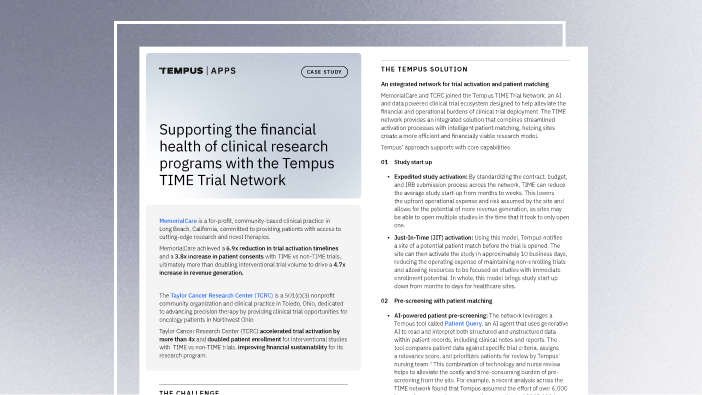
Supporting the financial health of clinical research programs with the Tempus TIME Trial Network
By combining the power of AI-driven technology with a streamlined operational model, Tempus provides the infrastructure and support to enable sites with limited resources to participate in research and expand their capabilities.
Read more -
 01/20/2026
From image to insight: How Tempus is leveraging AI to advance biomarker screening at scale
By leveraging Paige Predict to screen for genomic and phenotypic biomarkers, clinicians and researchers have rapid access to valuable information to prioritize testing and pre-screen patients at scale.
Read more