-
PROVIDERS
Learn more
Join Tempus at the 2026 ASCO® Annual Meeting!
-
LIFE SCIENCES
Read case study
Learn now Tempus Next Pathways unlocked critical insights into the aNSCLC patient journey with Bristol Myers Squibb (BMS)
-
PATIENTS
It's About Time
View the Tempus vision.
- RESOURCES
-
ABOUT US
View Job Postings
We’re looking for people who can change the world.
- INVESTORS
03/12/2026
Beyond imaging: Using molecular data to personalize cancer care
In a recent webinar, Dr. Ezra Cohen, Chief Medical Officer of Oncology at Tempus, and Dr. Alan Tan, Associate Professor of Medicine at Vanderbilt University, explored the evolving landscape of MRD testing.
Authors
Ezra Cohen, MD
Chief Medical Officer of Oncology, Tempus

Alan Tan
MD, Associate Professor of Medicine, GU Medical Oncology, Vanderbilt University Medical Center

Chief Medical Officer of Oncology, Tempus
Alan Tan
MD, Associate Professor of Medicine, GU Medical Oncology, Vanderbilt University Medical Center
Introduction
Traditional cancer surveillance relies on imaging and clinical assessments, which have known limitations in detecting residual disease. This can lead to delayed detection of recurrence or ambiguous results. The emergence of minimal residual disease (MRD) testing, which uses circulating tumor DNA (ctDNA) to find trace amounts of cancer, is shifting the paradigm from reactive treatment to proactive molecular monitoring.
In a recent webinar, Dr. Ezra Cohen, Chief Medical Officer of Oncology at Tempus, and Dr. Alan Tan, Associate Professor of Medicine at Vanderbilt University, explored the evolving landscape of MRD testing. They discussed its role in risk stratification, treatment decision-making, and response monitoring, highlighting how these powerful tools are personalizing cancer care across the patient journey. This article summarizes the key questions and insights from their discussion.
What is the difference between minimal residual disease (MRD) and treatment response monitoring (TRM)? |
| Dr. Ezra Cohen: While the underlying technology may be the same, the terms apply to different clinical contexts. When we talk about MRD, we are referring to the small number of cancer cells that can remain in the body after curative-intent treatment. This microscopic disease is undetectable by conventional imaging. Treatment response monitoring, on the other hand, involves tracking changes in a patient’s ctDNA levels over time to see how their cancer is responding to therapy in the metastatic setting. |
What are the differences between tumor-informed and tumor-naive MRD tests, and when should each be used? |
Dr. Alan Tan: The main difference lies in the need for a tumor sample. A tumor-naive test, like Tempus’ xM for colorectal cancer, does not require tissue. It uses a blood sample to look for genomic and epigenomic patterns specific to a cancer type. Its key advantage is a rapid turnaround time, making it ideal for time-sensitive adjuvant treatment decisions, especially when tissue is unavailable.
Dr. Ezra Cohen: A tumor-informed assay, like the xM (NeXT Personal® Dx) offered by Tempus, uses whole-genome sequencing of a patient’s tumor to create a personalized panel of up to 1,800 variants. This bespoke approach provides ultra-high sensitivity and specificity. It is ideal for long-term surveillance and immunotherapy response monitoring, where detecting the lowest levels of ctDNA is critical. |
How does MRD testing inform adjuvant therapy decisions, particularly in cases like stage II colorectal cancer? |
| Dr. Alan Tan: Stage II colorectal cancer is a setting where the decision to give adjuvant chemotherapy can be difficult. The risk of recurrence is relatively low, but the treatment carries significant toxicity. An MRD-positive result provides a powerful prognostic data point that can clarify risk far better than clinical stage alone. If a patient is MRD-positive after surgery, it indicates the presence of residual disease. This information can help you and your patient make a more confident decision about initiating adjuvant therapy to target that micrometastatic disease. |
How do you counsel a patient who has a positive MRD result but clear imaging? |
| Dr. Alan Tan: This is a common and important question. I explain to patients that imaging is a snapshot in time, while ctDNA gives us a real-time view of tumor biology with a lead time that can be six months or more. For a patient with a positive MRD result and clear scans, I would increase the frequency of surveillance to monitor the kinetics of their ctDNA. It’s also important to remember that not every low-level positive result leads to immediate progression; sometimes the immune system can clear it. The key is to use the information to be more vigilant and prepared to act if the levels begin to rise. |
How can MRD or TRM testing help differentiate between true progression and pseudoprogression during immunotherapy? |
| Dr. Alan Tan: Pseudoprogression is a known phenomenon where a tumor can appear larger on a scan after starting immunotherapy due to T-cell infiltration, even when the treatment is working. This can lead to prematurely stopping an effective therapy. ctDNA kinetics provide a more accurate picture. If a patient’s scans show tumor growth but their ctDNA levels are dropping dramatically, it is a strong indicator of pseudoprogression, not true disease progression. This gives you the confidence to continue treatment and reassure the patient that the therapy is having a biological effect. |
What is the role of MRD testing in the neoadjuvant setting? |
| Dr. Alan Tan: Data from studies like NeoADAURA in non-small cell lung cancer (NSCLC) show that ctDNA is a powerful tool for assessing response to neoadjuvant therapy with the use of xM (NeXT Personal® Dx). In that trial, patients who cleared their ctDNA after treatment had a 96% event-free survival at 18 months. Conversely, patients who were ctDNA-positive at baseline were four times more likely to experience recurrence. This shows that ctDNA status before and after neoadjuvant treatment is highly prognostic and may help guide future treatment decisions, such as whether to proceed with a morbid surgery. |
How does the sensitivity of an MRD assay impact its clinical utility? |
| Dr. Alan Tan: This is crucial in historically low-shedding tumors like kidney cancer. With an ultra-sensitive, tumor-informed assay, we are now able to pick up ctDNA at just a few parts per million, even in patients with low-volume lung metastases. This capability opens the door for more effective surveillance in tumor types where molecular monitoring was previously challenging. |
Conclusion
MRD testing is rapidly reshaping the oncology landscape by providing a molecular-level view of a patient’s cancer. As demonstrated by Dr. Cohen and Dr. Tan, these assays are already proving to be powerful prognostic tools that can guide adjuvant therapy, clarify ambiguous imaging, and monitor treatment response. As prospective data continues to emerge, MRD testing is poised to move beyond risk stratification and become a new standard for guiding proactive, individualized cancer care.
| To gain comprehensive insights into Tempus’ role in advancing precision medicine, we invite you to watch the webinar recording. For in-depth demonstrations of our AI-enabled applications, contact us here. |
-
 05/05/2026
From recurrence monitoring to treatment response: MRD data insights across the cancer care continuum
This session will explore how minimal residual disease (MRD) data provides critical insights across the cancer care continuum.
Watch replay -
 04/02/2026
Unlocking foundation models: Our experience from proof of concept to deployment at scale
An executive discussion on leveraging multi-modal foundation models to accelerate your drug development journey
Watch replay -
 03/04/2026
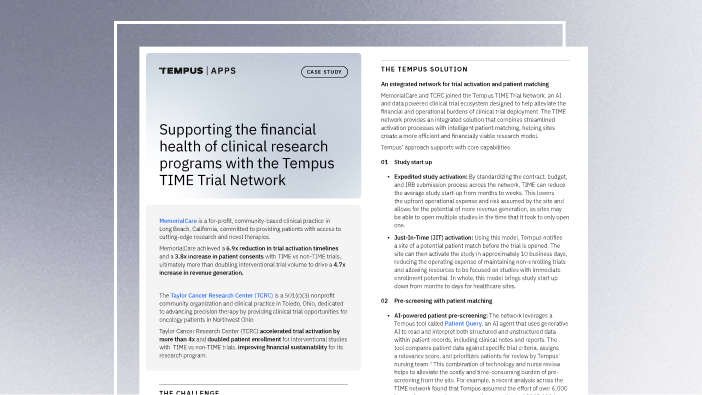
Supporting the financial health of clinical research programs with the Tempus TIME Trial Network
By combining the power of AI-driven technology with a streamlined operational model, Tempus provides the infrastructure and support to enable sites with limited resources to participate in research and expand their capabilities.
Read more