-
PROVIDERS
New MRD Medicare Coverage for Select Indications*
*When coverage criteria are met. Additional criteria and exceptions for coverage may apply.
-
LIFE SCIENCES
Register now
UPCOMING WEBINAR
Unlocking Foundation Models: Our experience from proof of concept to deploying at scale -
PATIENTS
It's About Time
View the Tempus vision.
- RESOURCES
-
ABOUT US
View Job Postings
We’re looking for people who can change the world.
- INVESTORS
02/01/2026
Tempus Offers Combined DNA and RNA Sequencing for Precision Oncology
Key Takeaways:
- Tempus comprehensive test offerings include xT CDx, xR, xT, xF/xF+, and xE.
- 21% more patients with driver fusions eligible for FDA-approved targeted therapies were identified with DNA + RNA sequencing compared to DNA sequencing alone.
- This large, real-world dataset demonstrates that RNA NGS increases ALK fusion detection by 18% over DNA alone for patients with advanced NSCLC.
Combined DNA and RNA Sequencing for Precision Oncology
- DNA SEQ + WHOLE TRANSCRIPTOME RNA SEQ enable a more complete understanding of clinically actionable fusions and altered splicing.
- 21% more patients with driver fusions eligible for FDA-approved targeted therapies were identified with DNA + RNA sequencing compared to DNA sequencing alone.
- xT CDx is an FDA-Approved Tumor Profiling for Solid Tumor Malignancies involving a 648 gene solid tumor + normal match DNA sequencing panel.
- xR is a Whole-transcriptome RNA sequencing panel for Solid Tumor + Hematologic Malignancies.
- xT is a 648 gene DNA sequencing panel for Solid Tumor Only or Hematologic Malignancies.
- xF/xF+ is a Liquid Biopsy 105/523 gene ctDNA sequencing panel.
- xE is a Whole Exome 19,000+ gene DNA sequencing panel.
Tempus xT Heme + xR
- xT Heme + xR is a comprehensive assessment of DNA (648 genes) and RNA whole transcriptome sequencing, respectively, offering validated fusion detection*, prognostic and/or diagnostic considerations, and therapeutic matching for hematologic malignancies.
- POTENTIAL USES FOR xT HEME + xR.
- Myelodysplastic Syndromes (MDS): xT Heme + xR can aid in diagnosis, provide information on clonality in uncertain cases, and assess prognosis using IPSS-M.
- Acute Leukemias: xT Heme + xR can help inform subclassification and prognosis, guide treatment decisions and risk stratify patients based on molecular findings.
Tempus xT + xR RNA sequencing
- 43.4% of patients were matched to a targeted therapy when DNA seq, RNA seq, and immune biomarker assessment were combined, compared to 29.6% of patients who had a therapy match using DNA seq alone.
- Among patients with identified fusions, 29% more patients were identified with a unique clinically actionable fusion that could be matched to a targeted therapy when RNA seq was incorporated, compared to DNA seq alone.
- Solid tumor + normal match testing is a method of parallel DNA sequencing of a solid tumor and normal patient sample (blood or saliva) that distinguishes somatic vs potential germline alterations, aiding in treatment decisions.
- 28% reduction in somatic false-positive calls, improving accuracy compared to tumor-only analysis.
- ~7% of cancer patients were found to harbor pathogenic or likely pathogenic germline variants across multiple tumor types, and may be indicated for confirmatory germline testing.
- xR offers whole transcriptome RNA sequencing for solid tumors and hematologic malignancies.
- It provides actionable insights by identifying clinically relevant* fusions across more than 100 targeted genes†, along with altered splicing events such as MET exon 14 and EGFRvIII, all through an unbiased and comprehensive manner.
- Examples of targeted genes include but are not limited to: ALK, RET, ROS1, NTRK1/2/3, FGFR1/2/3, NRG1, BRAF, EWSR1, ESR1-CCDC170, MYB-NFIB, PML-RARA, BCR-ABL.
Tempus xR
- xR is a whole transcriptome RNA-seq panel for solid tumors and hematologic malignancies that reports clinically relevant fusions for more than 100 targeted genes, as well as altered splicing events for MET exon 14 and EGFRvIII.
- Depth of sequencing: 50 million reads (avg.)
- Sensitivity: 97% for rearrangements/ fusions, 100% for altered splicing (MET Exon 14), 95.5% for altered splicing (EGFRvIII).
- In addition to fusion detection, RNA-seq offers several advantages to biopharma and researchers—from target discovery and selection through CDx development.
- Molecular Characterization: Characterizing the prevalence or degree of overexpression in late-stage tumors.
- Trial Recruitment: Screening patients for overexpression of genes to be used as a surrogate for IHC or screening tool to identify patients likely to be IHC+ for multiple tests.
Tempus Launches Standalone RNA Sequencing Test, xR
- Tempus, a leader in artificial intelligence and precision medicine, today introduces its standalone RNA next-generation sequencing assay, Tempus xR.
- xR is a whole transcriptome panel for solid tumors, reporting clinically relevant fusions for more than 100 targeted genes, as well as altered splicing for MET Exon 14 and EGFRvIII.
- “RNA sequencing has already been a hallmark of our comprehensive testing solutions, and we’re thrilled to now introduce it as a standalone offering,” said Kate Sasser, PhD, Chief Scientific Officer at Tempus.
- Whole transcriptome RNA sequencing can detect actionable fusions and altered splicing events, alongside detailed gene expression data for research use. Having a standalone option will increase flexibility for our physicians and biopharma partners to address a variety of precision medicine questions.
Actionable Structural Variant Detection via RNA NGS and DNA NGS in Patients with Advanced Non-Small Cell Lung Cancer
- Concurrent RNA-NGS and DNA-NGS identified 15.3% more patients harboring aSVs compared with DNA-NGS alone (491 vs 426 patients, respectively), including 14.3% more patients harboring actionable fusions (376 vs 329 patients) and 18.6% more patients harboring MET exon 14 skipping alterations (115 vs 97 patients).
- Main Outcomes and Measures included detection rates of NCCN guideline–based structural variants (ALK, ROS1, RET and NTRK1/2/3 fusions, as well as MET exon 14 skipping splicing alterations) found uniquely by RNA-NGS.
- The prevalence of actionable structural variants detected by either RNA-NGS or DNA-NGS was 8.8% (n = 491), with 86.7% (n = 426) of these detected by DNA-NGS.
- Emerging structural variants (eSVs) were found to have a combined prevalence to be 0.7%, with only 47.5% of eSVs detected by DNA-NGS.
ALK Fusion Detection by RNA Next-Generation Sequencing (NGS) Compared to DNA in a Large Real-World Non-Small Cell Lung Cancer (NSCLC) Dataset
- This large, real-world dataset demonstrates that RNA NGS increases ALK fusion detection by 18% over DNA alone for patients with advanced NSCLC.
- Among 7,428 NSCLC patients, 2.9% had ALK fusions (n=217), with 83% (n=180) detected by both DNA and RNA, 15% (n=33) from RNA alone, and 2% (n=4) from DNA alone.
- Most cases had canonical breakpoints in RNA (n=26), where 18 had no DNA support in these breakpoints, suggesting complex ALK rearrangements in DNA.
- Of those with medication data (n=7), 6 patients with EML4-ALK fusions detected by RNA alone received targeted therapy post-testing and 5 remained on therapy for ≥100 days.
Concurrent DNA and RNA NGS Testing to Characterize Rare Fusions in Advanced NSCLC Patients
- The overall prevalence of rare fusions in our cohort was 0.6% (n=32): 0.3% (n=18) BRAF, 0.2% (n=9) NRG1, and 0.1% (n=5) EGFR.
- Fifty percent (n=16) of the rare fusions were detected solely by RNA-seq—including 66.7% (n=12) of BRAF, 22.2% (n=2) of NRG1, and 40% (n=2) of EGFR.
- Concurrent DNA-RNA NGS improved the detection rate of emerging rare fusion variants in advanced NSCLC patients compared to DNA-NGS, doubling the number of rare fusions detected and eligible patients that may benefit from targeted therapy.
- Seven out of 8 patients with co-occurrence of BRAF fusions and EGFR SNV/indels, with concomitant treatment information, were treated with EGFR-targeted therapy prior to sequencing, implicating the clonal emergence of BRAF fusions as a possible resistance mechanism to anti-EGFR therapy.
Tempus DNA and RNA Sequencing
- Tempus leverages best-in-class laboratories to provide a variety of next-generation sequencing (NGS) tests and targeted arrays to support testing needs from discovery through to commercialization.
- Our assays include Tempus xT CDx, Tempus xR IVD, Tempus xT, Tempus xR, Tempus xE, and Tempus xH.
- TEMPUS ECOSYSTEM: One integrated solution for all phases of drug development.
- Tempus Data: The largest multimodal database library of more than 6 million de-identified research records to support novel biomarker discovery, hypothesis validation, and late stage clinical trial design.
- Tempus xE: Whole exome, tumor/normal matched and whole transcriptome RNA-seq.
- RNA: ~50 million reads
Testing Resources
- Each Comprehensive Therapy Selection (CTS) order for solid tumor cancers includes xT CDx (DNA), xR (RNA), and a curated selection of biomarker tests based on your patient’s cancer type (see table below).
- For hematologic malignancies, a Comprehensive Therapy Selection order will include xT Heme (DNA) and xR (RNA).
- Curated Biomarker Tests Based on Patient Cancer Type for Non-small cell lung cancer: HER2, PD-L1 (22C3), PD-L1 (SP142), PD-L1 (SP263), PD-L1 (28-8), IPS.
- xT CDx is a qualitative Next Generation Sequencing (NGS)-based in vitro diagnostic device intended for use in the detection of substitutions (single nucleotide variants (SNVs) and multi-nucleotide variants (MNVs)) and insertion and deletion alterations (INDELs) in 648 genes, as well as microsatellite instability (MSI) status, using DNA isolated from Formalin-Fixed Paraffin Embedded (FFPE) tumor tissue specimens, and DNA isolated from matched normal blood or saliva specimens, from previously diagnosed cancer patients with solid malignant neoplasms.
Tempus Publishes Study Highlighting Benefits of Concurrent RNA and DNA Sequencing in Advanced Cancer Care
- Tempus recently conducted a retrospective study of more than 5,500 patients with advanced non-small cell lung cancer (NSCLC) and found that concurrent RNA- and DNA-based next-generation sequencing (NGS) led to the detection of more actionable structural variants compared to DNA sequencing alone.
- “This large study underscores the importance of using both RNA- and DNA-based comprehensive genomic profiling as a standard of care in advanced NSCLC, and more broadly in solid tumors,” said Halla Nimeiri, MD, Chief Development Officer at Tempus.
- Overall, the concurrent use of RNA and DNA sequencing resulted in a 15.3% increase in identifying patients with actionable variants and more than doubled the detection of emerging, rare structural variants compared to DNA sequencing alone.
Tempus Onco Comprehensive Therapy Selection Overview
- Included in every Comprehensive Therapy Selection order for solid tumor cancers: xT CDx (DNA), xT LDT (DNA), and xR (RNA).
- xR (RNA): Whole transcriptome RNA sequencing test.
- xT LDT (DNA): Solid tumor testing if a matched normal specimen is unavailable or if the normal specimen cannot be successfully sequenced.
Tempus Onco Clinical Report Guide
- Chromosomal Rearrangements (Translocations): A change to the structure of a chromosome, such as a deletion, duplication, inversion or translocation.
- Chromosomal rearrangements can bring two distant gene fragments together to form fusion genes.
- Loss of Heterozygosity (LOH) occurs when there is loss of the second, wild-type copy of a gene that already has an inactivating alteration in the first copy.
- When LOH is detected for germline BRCA1 and BRCA2 variants, it is displayed as a copy number loss on the report, and the gene description for the copy number loss will note that somatic LOH was identified.
- Tempus detects rearrangements (translocations) through two lines of sequencing: DNA sequencing for a subset of genes, and unbiased fusion transcript detection using whole transcriptome RNA sequencing.
-
 03/27/2026
Impact of M2-like macrophage infiltration on RCC immunotherapy outcomes
Tempus Lens analysis reveals how immune profiling enhances macrophage predictive value
Read more -
03/27/2026
Developing a gene expression signature for first-line treatment in metastatic CRC
Tempus RWD identifies a signature predictive of bevacizumab response in CRC
Read more -
 03/27/2026
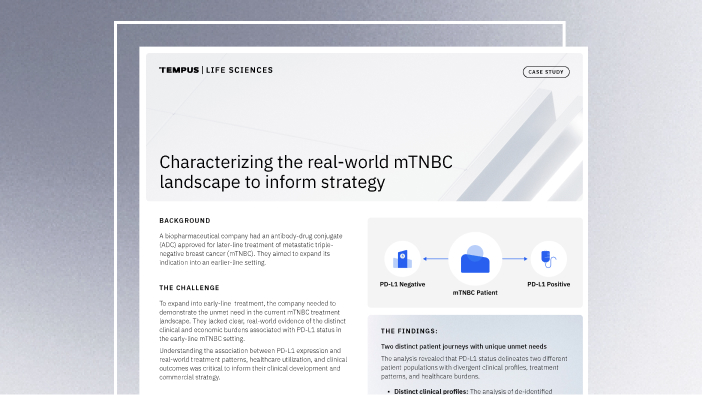
Characterizing the real-world mTNBC landscape to inform strategy
Learn how Tempus’ analysis of multimodal real-world data helped a biopharmaceutical company identify distinct patient journeys and healthcare burdens in mTNBC based on PD-L1 status, enabling them to refine their clinical and commercial strategy.
Read more