-
PROVIDERS
New MRD Medicare Coverage for Select Indications*
*When coverage criteria are met. Additional criteria and exceptions for coverage may apply.
-
LIFE SCIENCES
Register now
UPCOMING WEBINAR
Unlocking Foundation Models: Our experience from proof of concept to deploying at scale -
PATIENTS
It's About Time
View the Tempus vision.
- RESOURCES
-
ABOUT US
View Job Postings
We’re looking for people who can change the world.
- INVESTORS
02/02/2026
How Does Tempus Support Target Validation?
Key Takeaways
- Tempus Loop is a platform combining real-world data (RWD) and patient-derived organoids (PDOs) to accelerate target identification and validation.
- Assess target expression, function, and druggability using tumor organoid models to evaluate its biological relevance.
- We can use them in target validation work, translational biomarker efforts, indication expansion, predictive biomarker discovery, combination strategy, and many other opportunities.
Biological Modeling
- Our vast tumor organoid repository enables new possibilities for therapy selection and drug discovery. We aim to transform therapy selection and drug discovery and development by building one of the world’s largest libraries of human ex vivo tumor-derived organoids that are characterized by molecular features and associated clinical outcomes in robust, reproducible 3D models.
- Test and evaluate your preclinical drug candidates with our fixed PDO panels, designed for diverse therapeutic applications and offered on a rotating quarterly schedule.
- Predefined sets of organoid models enriched for specific characteristics (e.g., indication, biomarker, clinical data) can be used to screen test compounds and to test and generate hypotheses.
- Compounds can be screened alone and in combinations, providing a rapid and cost-effective alternative to in vivo preclinical animal experiments.
- Characterize cell populations of interest with precision–identify and validate complex signatures and identify biomarkers of therapeutic response.
- Our solutions can be broadly applied to preclinical and post-approval strategies.
- Biomarker and target validation.
- Indication selection.
- Exploratory (MOA) studies.
- Exploration of rare patient mutations and alterations.
- Combination identification and validation.
Connecting Real-World Data and Organoids for Target Discovery
- Tim Hagerty, Ph.D, VP, Life Science Strategy at Tempus, discusses Tempus Loop, a platform aimed at enhancing target identification and validation by connecting real-world data with patient-derived organoids.
- Simply put, Tempus Loop is a platform combining real-world data (RWD) and patient-derived organoids (PDOs) to accelerate target identification and validation.
- We leverage our de-identified, multimodal data, enhanced with AI and external datasets, to identify candidate targets.
- These targets are then tested using our PDO models, which utilize the same next-generation sequencing tests—Tempus xT (DNA-seq) and Tempus xR (RNA-seq)—as our RWD, ensuring validation.
- We marry our AI-enabled RWD platform containing DNA, RNA, single-cell RNA-seq, spatial data, clinical data, knowledge graphs, and histopathology data with public datasets to identify multimodal cohorts and enable target identification through network mapping within a systems biology approach.
Life Sciences Solutions | RWD & Clinical Development
Target Validation & Lead Optimization.
- Explore a target’s involvement in cancer progression and therapeutic actionability.
- Assess target expression, function, and druggability using tumor organoid models to evaluate its biological relevance.
- Leverage real-world toxicity, resistance, and treatment-response data to further validate targets and refine drug candidates.
Novel Target Identification.
- Investigate possible novel target candidates while considering oncogenic dependencies via high-throughput functional screening.
- Refine candidate selection using computational modeling and AI-powered omics solutions to predict druggability, pathway redundancy, and tumor specificity.
- Investigate therapeutic relevance of emerging targets through validation studies using tumor organoid models, enabling a data-based prioritization of first-in-class or best-in-class therapeutic approaches.
Using Multimodal Real-World Data for Decision-Making
- The use of multimodal real-world data (RWD) creates a wealth of opportunity for researchers – it can confirm existing knowledge, uncover new hypotheses about tumor biology, and de-risk future efforts to increase the probability of success of a clinical trial.
- We strive to stay informed of new technologies and approaches that could help us answer questions posed in our biomarker strategy and that included building a new domain of expertise, a molecular epidemiology function.
- Having access to larger, independent datasets is critical to de-risk a hypothesis prior to a prospective trial, which hasn’t been easy in the past.
- Our first major foray into this field was assembling a cohort in advanced non-small cell lung cancer (aNSCLC) to compare checkpoint inhibitor therapy, checkpoint inhibitor plus chemo, or chemo-alone cohorts to test patient stratification hypotheses.
- We examined specific target expression and inferred pathway activity from the transcript data, together with DNA profiling.
- Our initial aim was a pragmatic approach to explore the molecular profiles of tumors that display primary resistance to a specific therapeutic regimen.
- We can use them in target validation work, translational biomarker efforts, indication expansion, predictive biomarker discovery, combination strategy, and many other opportunities.
-
 03/27/2026
Impact of M2-like macrophage infiltration on RCC immunotherapy outcomes
Tempus Lens analysis reveals how immune profiling enhances macrophage predictive value
Read more -
03/27/2026
Developing a gene expression signature for first-line treatment in metastatic CRC
Tempus RWD identifies a signature predictive of bevacizumab response in CRC
Read more -
 03/27/2026
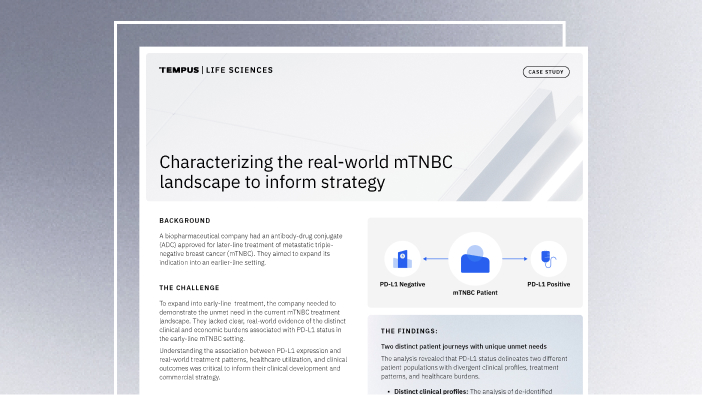
Characterizing the real-world mTNBC landscape to inform strategy
Learn how Tempus’ analysis of multimodal real-world data helped a biopharmaceutical company identify distinct patient journeys and healthcare burdens in mTNBC based on PD-L1 status, enabling them to refine their clinical and commercial strategy.
Read more