-
PROVIDERS
REGISTER NOW
Upcoming Webinar:
MRD data insights across the cancer care continuum -
LIFE SCIENCES
Read now
Accelerating a phase 1 oncology trial: The TIME Network's impact on patient enrollment
-
PATIENTS
It's About Time
View the Tempus vision.
- RESOURCES
-
ABOUT US
View Job Postings
We’re looking for people who can change the world.
- INVESTORS
11/01/2025
Solutions for identifying and closing care gap
What to know:
- Tempus Next provides near real-time alerts to clinicians, identifying patients who have fallen off care guidelines, and Tempus One turns digital health records into a structured timeline of clinical events.
- This hybrid approach is unlocking the ability to answer novel research questions that were previously out of reach, and AI-enabled abstraction processed 60,000 patient records in just a few days.
- The ability to place biopsies within a patient’s full clinical journey is a key advantage for studying both innate and acquired resistance, and Tempus Lens allows researchers to quickly build specific patient cohorts using a wide range of filters.
- Tempus One can process millions of de-identified documents and provide initial answers in a fraction of the time, while agents help identify trial-eligible patients and gather relevant patient information.
AI in Healthcare in 2026 and Beyond
Tempus Next provides near real-time alerts to clinicians, identifying patients who have fallen off care guidelines, as well as feedback to help institutions understand trends in their patient population. AI helps streamline the process and get the right information to physicians as soon as a therapy or biomarker becomes relevant. In this way, an AI tool integrated into the electronic health record (EHR) can act as a safety net. A great example is the ESR1 mutation in metastatic breast cancer, which is an emerging mutation that develops after a patient starts endocrine therapy and can be difficult to identify at the right time in a patient’s journey. Every patient’s journey is unique. Using an LLM-based data science model, Tempus One turns digital health records into a structured timeline of clinical events, featuring diagnostic results, changes in treatment, and more.
Read more
AI-enabled data abstraction transforms Tempus data
This hybrid approach is doing more than just increasing speed and scale; it’s unlocking the ability to answer novel research questions that were previously out of reach. When we bring AI into the loop, it serves to augment and enable this human-led process. This “human-in-the-loop” framework ensures that even as we scale, our commitment to data quality and accuracy remains our central focus. A powerful example is a project that required us to identify patients with hemophagocytic lymphohistiocytosis (HLH), a rare and serious secondary condition that can occur after certain cancer treatments. Manually searching for these patients across our entire database would have been like finding a needle in a haystack. Using AI, we were able to scan thousands of de-identified records in a fraction of the time required for human screening, allowing us to identify a smaller, enriched cohort of patients who were more likely to have this rare condition. In a recent pilot, our AI-enabled abstraction processed 60,000 patient records in just a few days—a task that would have previously taken a large team of our abstractors months to complete.
Read more
Q&A: Driving scientific discovery with real-world multimodal data
Fields, PhD: Our ability to place biopsies within a patient’s full clinical journey is a key advantage for studying both innate and acquired resistance. To understand acquired resistance, we can analyze biopsies collected after a patient has relapsed. This allows us to identify molecular changes, such as the emergence of an ESR1 mutation, that may be driving resistance. Fields, PhD: Our Tempus Lens platform provides a secure cloud environment to explore our data. It features a no-code interface that allows researchers to quickly build specific patient cohorts using a wide range of filters, including diagnosis, treatment history, and molecular features.
Read more
Tempus One Introduces New GenAI Capabilities to Query Millions of Unstructured Documents for Research and Clinical Care
As part of its clinical trial matching program, TIME, Tempus is now deploying an internal agent that allows the company to analyze providers’ structured and unstructured data to create a queue of patients that may be eligible for a specific trial. This agent can tap into unstructured data, such as progress notes, pathology reports, and imaging scans, which are important to understanding if a patient may be eligible for a trial. Tempus then sends the provider a notification for each patient that may be a match for that trial. Now, a new agent inside of Hub, Tempus’ provider platform, helps clinicians gather pertinent guidelines, drug labels, payer policy, and other relevant patient information, and outputs support documents tailored to each patient’s case for further use by their care team. Typically, real-world research has been hindered by manual chart reviews and data abstraction, but Tempus One can process millions of de-identified documents and provide initial answers in a fraction of the time. In particular, this new functionality expands the ability to investigate adverse events and reported symptoms, an increasingly popular query for many Tempus biopharma research customers.
Read more
-
 04/03/2026
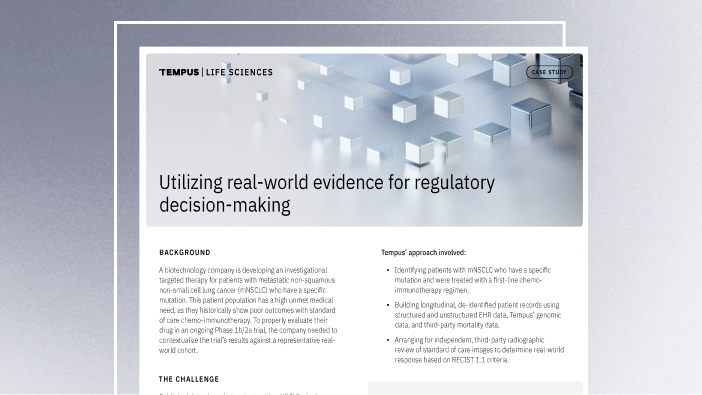
Utilizing real-world external controls for regulatory decision-making
A biotech company needed to contextualize its Phase 1b/2a trial for mNSCLC patients with a specific mutation. Learn how Tempus constructed a real-world external control arm to provide a benchmark for their regulatory submission.
Read more -
 03/27/2026
Impact of M2-like macrophage infiltration on RCC immunotherapy outcomes
Tempus Lens analysis reveals how immune profiling enhances macrophage predictive value
Read more -
03/27/2026
Developing a gene expression signature for first-line treatment in metastatic CRC
Tempus RWD identifies a signature predictive of bevacizumab response in CRC
Read more