-
PROVIDERS
REGISTER NOW
Upcoming Webinar:
MRD data insights across the cancer care continuum -
LIFE SCIENCES
REGISTER NOW
From insight to impact: Leveraging the AI-enabled Next platform with BMS to advance equitable access in precision oncology
-
PATIENTS
It's About Time
View the Tempus vision.
- RESOURCES
-
ABOUT US
View Job Postings
We’re looking for people who can change the world.
- INVESTORS
11/01/2025
AI-enabled cardiology solutions
What to know:
- Tempus Next Cardiology is an AI-enabled care pathway platform to help clinicians find patients with undiagnosed or undertreated cardiovascular or pulmonary disease.
- Tempus Next uses AI to support clinicians in closing care gaps by identifying patients who have not received treatment consistent with applicable guidelines and delivering customized and accurate notifications directly within an established clinical
- Tempus Pixel provides advanced viewing and automated reporting of cardiac MR images to help improve efficiency and accuracy in flow visualization and quantification, functional analysis, and tissue characterization.
Tempus Next Cardiology
Tempus Next Cardiology is an AI-enabled care pathway platform to help clinicians find patients with undiagnosed or undertreated cardiovascular or pulmonary disease. Tempus Next ingests multimodal data, runs AI-based algorithms, and surfaces insights for care teams to evaluate and action on. Solutions to Identify Underdiagnosed Patients include ECG-AI and Tempus Pixel Cardio. With deep regulatory experience, we are expanding our algorithms across 15+ disease areas in cardiology. Disease Areas include AORTA, Structural heart, Cardiomyopathies, Electrophysiology, Guideline Directed Medical Therapies, and Pulmonary Hypertension. Tempus Next includes screening algorithms for abdominal aortic aneurysms (AAA) and thoracic aortic aneurysms (TAA) using clinician reports from abdominal ultrasounds and CTs, in addition to all other available patient data. Tempus Next Structural Heart capabilities include screening for appropriate care across aortic stenosis, aortic regurgitation, mitral stenosis, mitral regurgitation, tricuspid regurgitation, and pulmonary regurgitation. Within cardiomyopathies, Tempus Next screening protocols address care across non-ischemic dilated cardiomyopathy and cardiac oncologic disease. Tempus Next electrophysiology capabilities include screening for risk of sudden cardiac arrest (SCA), risk of left atrial appendage thrombus, and atrial fibrillation. Tempus Next screens for an array of additional conditions including congestive heart failure and ischemic heart diseases. Tempus care gap algorithms help find undiagnosed or undertreated disease and close gaps in care at scale.
Read more
Solutions for Undertreated Patients
Tempus Next uses AI to support clinicians in closing care gaps by identifying patients who have not received treatment consistent with applicable guidelines and delivering customized and accurate notifications directly within an established clinical workflow.
- 2.5M+ patients screened
- 60K+ patients screened per month
- ~150+ hospitals nationwide are currently powered by Tempus Next
- 350+ EHR connected health systems across 2,000+ hospitals
Tempus Receives U.S. FDA 510(k) Clearance for Tempus ECG-Low EF Software.
Tempus AI, Inc. (NASDAQ: TEM), a technology company leading the adoption of AI to advance precision medicine and patient care, today announced it has received 510(k) clearance from the U.S. Food and Drug Administration (FDA) for its Tempus ECG-Low EF (ejection fraction) algorithm, which uses AI to detect signs associated with having a low left ventricular ejection fraction (LVEF ≤40%) in patients 40 years of age or older at risk of heart failure. INDICATIONS FOR USE: Tempus ECG-Low EF is software intended to analyze resting, non-ambulatory 12-lead ECG recordings and detect signs associated with having a low left ventricular ejection fraction (LVEF less than or equal to 40%). It is for use on clinical diagnostic ECG recordings collected at a healthcare facility from patients 40 years of age or older at risk of heart failure. This population includes but is not limited to patients with atrial fibrillation, aortic stenosis, cardiomyopathy, myocardial infarction, diabetes, hypertension, mitral regurgitation, and ischemic heart disease.
Read more
Tempus ECG-AI Solutions
Step 1: Patient Filtering: Tempus employs EHR integrations and patient clinical data to filter patients that may be eligible for Tempus ECG-AI device use based on IFU criteria.
Step 2: Patient Diagnosis: Tempus is pursuing development of Tempus ECG-AI based cardiology algorithms that can analyze physiological inputs using machine learning models, and detect signs associated with certain cardiovascular conditions for further referral or diagnostic follow-up.
Step 3: Patient Follow-up
Tempus uses AI to identify and contextualize patients in their journey, surface precision pathways at the point of care and track patients for further referral or diagnostic follow-up consistent with clinical care guidelines. The Tempus ECG-AF algorithm is intended for use to analyze recordings of 12-lead electrocardiogram (ECG) devices and detect signs associated with a patient experiencing AF within the next 12 months. INDICATIONS FOR USE: Tempus ECG-AF is intended for use to analyze recordings of 12-lead ECG devices and detect signs associated with a patient experiencing atrial fibrillation and/or atrial flutter (collectively referred to as AF) within the next 12 months. It is for use on resting 12-lead ECG recordings collected at a healthcare facility from patients: 65 years of age or older, without pre-existing or concurrent documentation of atrial fibrillation and/or atrial flutter, who do not have a pacemaker or implantable cardioverter defibrillator, and who did not have cardiac surgery within the preceding 30 days. ALERT Study: Addressing undertreatment and health equity in aortic stenosis and mitral regurgitation using an integrated EHR platform. MOMENTOUS Study: Assessing the clinical impact of an ECG algorithm to increase the diagnosis of pulmonary hypertension. NOTABLE Study: The NOTABLE (NOrthwestern Tempus AI-enBLed Electrocardiography) study will examine rates of new disease diagnosis, therapeutic interventions, and cardiovascular outcomes in patients managed by clinicians at Northwestern Medicine who use ECG predictive models compared to patients managed by clinicians at Northwestern Medicine who do not use the ECG predictive models. Effective January 1, 2025, CPT 3 +0764T and 0765T are listed under the Hospital Outpatient Prospective Payment and Ambulatory Surgical Center Payment Systems (OPPS) as Category III codes to describe assistive algorithmic electrocardiogram assessments for cardiac dysfunction.
Read more
Pixel for Radiology
Solution specifically designed to optimize how radiologists read images, detect findings, generate reports, and share insights with referring physicians. Automated image analysis: One-click segmentation of lesions on CT and MR images. Seamless integration: Easily integrates AI-enabled tools with existing PACS, EHR, worklist, notification, and dictation systems to optimize workflows. Pixel for Oncology: Solution specifically designed for oncologists to efficiently monitor disease progression. Automated quantification: Segments and measures lesions of interest, providing accurate contours and long axis and short axis measurements.
Read more
Tempus Pixel provides advanced viewing and automated reporting of cardiac MR images
Tempus Pixel provides advanced viewing and automated reporting of cardiac MR images to help improve efficiency and accuracy in flow visualization and quantification, functional analysis, and tissue characterization.
AI-enabled 4d flow: Visualize and quantify blood flow precisely anywhere in the heart and its major vessels based on 4D flow datasets, enabling reductions in scan time of up to 30%.
Functional Analysis: Automatically quantify cardiac chambers volumetry and ventricular function data from short axis datasets, enabling a reduction in segmentation time of up to 93% per study.
Tissue Characterization: Automatically quantify delayed enhancement, perfusion, and parametric mapping images (T1, T2 and T2*), with graphs and 17-segment models for faster and more informed decisions.
AI-based Myocardial Strain: Calculates strain, strain rate, and myocardial velocity that are reliable, quantitative, visually confirmable, and that separates normal from disease myocardial tissue.
Read more
Tempus Receives U.S. FDA Special 510(k) Clearance for Updated Tempus Pixel Device
CHICAGO, September 11, 2025 – Tempus AI, Inc. (NASDAQ: TEM), a technology company leading the adoption of AI to advance precision medicine, today announced it has received 510(k) clearance from the U.S. Food and Drug Administration (FDA) for its updated Tempus Pixel, an AI-powered cardiac imaging platform. This update allows the generation of T1 and T2 inline maps, further enhancing the device’s capabilities for cardiac MR image analysis. T1 and T2 maps provide precise numerical values to cardiac tissue characteristics, helping clinicians detect conditions such as fibrosis, inflammation, or edema, that may otherwise go undetected. With its newly cleared functionality, Tempus Pixel can now generate T1 and T2 inline maps directly from raw MRI data, even when the scanner itself does not produce them, calculating values at every pixel across the image to create detailed DICOM maps for comprehensive tissue assessment.
Read more
Tempus Announces Collaboration with Median Technologies to Integrate AI-Powered Lung Cancer Screening into the Pixel Platform
Tempus AI, Inc. (NASDAQ: TEM), a technology company leading the adoption of AI to advance precision medicine, today announced a collaboration with Median Technologies (EPA: ALMDT) to bring Median’s proprietary eyonis® LCS to the Tempus Pixel platform. eyonis® LCS is an AI-based CADe/CADx software as a medical device (SaMD) for lung cancer screening. By expanding our Pixel platform with sophisticated lung cancer screening AI tools, we are enabling radiologists to manage complex caseloads while prioritizing early-stage detection.
Read more
-
 04/21/2026
Tempus Next Pathways unlocked critical insights into the aNSCLC patient journey with Bristol Myers Squibb (BMS)
Discover how BMS collaborated with Tempus to deploy the Next Pathways program across 13 community-based health systems to address care gaps for patients with advanced non-small cell lung cancer (aNSCLC).
Read more -
 04/02/2026
Unlocking foundation models: Our experience from proof of concept to deployment at scale
An executive discussion on leveraging multi-modal foundation models to accelerate your drug development journey
Watch replay -
 04/03/2026
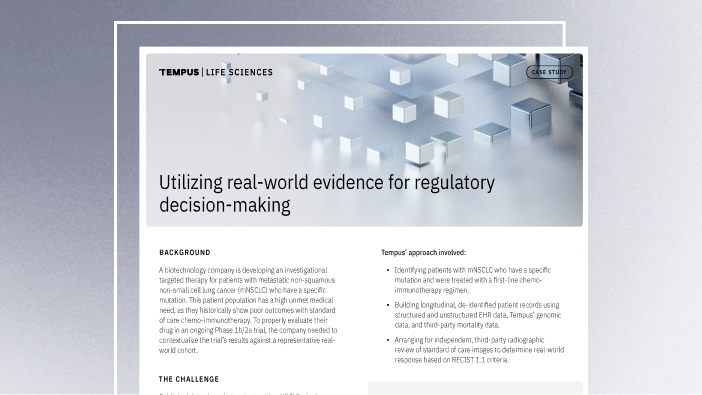
Utilizing real-world external controls for regulatory decision-making
A biotech company needed to contextualize its Phase 1b/2a trial for mNSCLC patients with a specific mutation. Learn how Tempus constructed a real-world external control arm to provide a benchmark for their regulatory submission.
Read more