-
PROVIDERS
REGISTER NOW
Upcoming Webinar:
MRD data insights across the cancer care continuum -
LIFE SCIENCES
Read now
Accelerating a phase 1 oncology trial: The TIME Network's impact on patient enrollment
-
PATIENTS
It's About Time
View the Tempus vision.
- RESOURCES
-
ABOUT US
View Job Postings
We’re looking for people who can change the world.
- INVESTORS
04/17/2026
Next-generation clinical research: An integrated solution for pre-screening
By automating patient identification, Tempus’ Next Trials platform can help accelerate accrual for active studies and unlock opportunities to advance research programs.
Authors
Noelle Gaskill, MBA, ACRP-CP
VP, General Manager, TIME Network, Tempus

Chelsea Osterman, MD
Executive Medical Director, Tempus

VP, General Manager, TIME Network, Tempus
Chelsea Osterman, MD
Executive Medical Director, Tempus
Identifying the right patients for clinical trials is a critical bottleneck that limits research progress. The Tempus Next Platform addresses this challenge with Next Trials, which equips research teams with intelligent, self-service pre-screening tooling. By automating patient identification, Next Trials may help you accelerate accrual for your institution’s studies and unlock new opportunities to advance your research program. This same technology also powers the Tempus TIME Trial Network, providing access to additional sponsored trial opportunities.
Introduction
The era of precision medicine has delivered an unprecedented number of clinical trials, yet more than 80% fail to meet their accrual timelines.¹ A key challenge is often not a lack of patients, but the difficulty in identifying the right patients for the right trial at the right time.
As trial eligibility criteria become more complex—often requiring specific genomic biomarkers, prior lines of therapy, and detailed clinical histories—the burden on research staff grows exponentially. This challenge is particularly acute in community hospital settings, which treat the vast majority of cancer patients but often lack the extensive research infrastructure of large academic medical centers.
The persistent challenge: pre-screening
The traditional method of manually reviewing patient records is no longer sustainable. Research staff must search for critical eligibility data buried within unstructured electronic health records (EHRs), a labor-intensive process that creates a significant constraint. Without dedicated tools, sites struggle to:
- Scale their efforts: Manually reviewing thousands of patient records for a single trial is inefficient and difficult to scale across a portfolio of studies.
- Maintain precision: The risk of overlooking a potentially eligible patient is high when critical data is fragmented across multiple systems and unstructured documents.
- Act quickly: The window of opportunity for enrolling a patient can be narrow, and delays in identification mean patients may begin another line of treatment or become ineligible.
This operational obstacle may hinder a site’s ability to meet accrual goals and limits its capacity to offer patients the full spectrum of available research opportunities. Tempus Next empowers research institutions with intelligent, AI-powered tools to help transform patient identification from a manual burden into a scalable, data-driven workflow – ultimately reaching patients faster with trials.
A new approach: AI-powered platforms for clinical research
Designed to streamline the clinical research workflow, the Next Platform connects to your health system’s EHR through a single, secure integration that interacts with structured data, unstructured documents, scanned documents and images. Next Trials puts powerful AI tools directly into the hands of your research staff, empowering your site to identify potential trial candidates with greater speed and precision.
This approach is delivered through the Next Trials module, combining two powerful strategies: self-service pre-screening tools and high-fidelity matching services.
- Transforming patient identification with self-service pre-screening
This self-service model allows your site to pre-screen their entire patient population against the criteria for trials they are running. Key capabilities include:- AI-driven cohort building: Leveraging AI agents, users can build specific patient cohorts in seconds by querying both structured and unstructured multimodal data. For example, a coordinator can identify all patients with metastatic non-small cell lung cancer who have a specific biomarker and have progressed after a certain therapy.
- Automated record analysis: The platform uses AI to read and interpret unstructured data from clinical notes and reports, surfacing relevant information and linking back to the source document for easy verification.
- Integrated workflows and analytics: A centralized dashboard provides a comprehensive view of individual patient journeys, including upcoming visits, treatment timelines, and biomarker testing results. At the practice level, you can also view performance metrics and analytics, offering a broader perspective on your research program’s performance and helping you manage workflows more efficiently.
By automating the most time-consuming aspects of patient identification, Next Trials allows research staff to focus their expertise on validating potential matches and engaging with patients, ultimately accelerating accrual for trials already active at their institution. - Delivering high-fidelity matches with expert review
The same AI-powered tools that empower staff to conduct pre-screening for trials is also the engine that powers the Tempus TIME clinical trial network. Institutions participating in the TIME network access this technology complemented by our white-glove patient matching service for sponsored oncology trials. For patient matching at TIME, potential matches identified by the Next Trials platform are reviewed by Tempus’ oncology research nurses to confirm alignment with complex trial criteria. This delivers a curated list of high-confidence candidates to your site, reducing the pre-screening burden for sponsored trials and increasing the likelihood of successful accrual. The Next Platform also provides dashboards to track trial metrics and performance for these network studies.Together, these technology and service-based solutions create a comprehensive ecosystem that supports institutions at every stage of the clinical trial process, from feasibility and study start-up to patient identification and accrual.
Practical implications for research institutions
Adopting an AI-powered platform like Tempus Next provides tangible benefits for both clinical research staff and leadership.
|
For clinical research staff
|
For research leadership
|
Conclusion
A critical opportunity in clinical research is to bridge the gap between the growing number of available trials and the patients who stand to benefit from them. As trial complexity increases, the traditional, manual approach to patient identification presents significant challenges to meeting this need.
By embracing AI-powered platforms, research institutions can unlock the full potential of their clinical data, streamline their workflows, and build more efficient and scalable research programs. Tempus Next provides institutions of all sizes with advanced tools and services to accelerate clinical research and empower teams to identify and contextualize the right patients for clinical trials, helping drive the next wave of innovation in precision medicine.
| Contact us to learn more about how Tempus Next can empower your research program. |
References
1. Unger, J. M., Vaidya, R., Hershman, D. L., Minasian, L. M., & Fleury, M. E. (2019). Systematic review and meta-analysis of the magnitude of structural, clinical, and physician and patient barriers to cancer clinical trial participation. Journal of the National Cancer Institute, 111(3), 245–255.
-
 03/04/2026
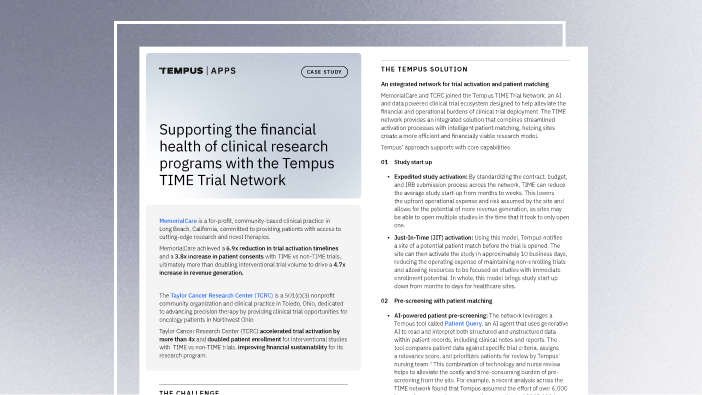
Supporting the financial health of clinical research programs with the Tempus TIME Trial Network
By combining the power of AI-driven technology with a streamlined operational model, Tempus provides the infrastructure and support to enable sites with limited resources to participate in research and expand their capabilities.
Read more -
 01/20/2026
From image to insight: How Tempus is leveraging AI to advance biomarker screening at scale
By leveraging Paige Predict to screen for genomic and phenotypic biomarkers, clinicians and researchers have rapid access to valuable information to prioritize testing and pre-screen patients at scale.
Read more -
 12/04/2025
Pioneering decentralized oncology trials: Success at the nation’s largest community practices
Hear directly from industry leaders and pioneering site partners as they share insights on expanding their research footprint and improving financial sustainability for their institutions.
Watch replay