-
PROVIDERS
REGISTER NOW
Upcoming Webinar:
MRD data insights across the cancer care continuum -
LIFE SCIENCES
REGISTER NOW
From insight to impact: Leveraging the AI-enabled Next platform with BMS to advance equitable access in precision oncology
-
PATIENTS
It's About Time
View the Tempus vision.
- RESOURCES
-
ABOUT US
View Job Postings
We’re looking for people who can change the world.
- INVESTORS
04/27/2026
High and Stable MUC16 Expression in Endometrial Cancer Highlights Potential for Targeted Antibody-Drug Conjugate Development
SGO 2026
PRESENTATION
Authors
Kathleen Moore, David O'Malley, Michael Birrer, Robert Coleman, Fernanda Musa, Maria Rubinstein, Ritu Salani, Dayana Delgado, Lennart Langouche, David Dornan, Kathleen Keegan, David Lennon, Ashwini Pai, Ursula Matulonis
Objectives
The glycoprotein MUC16 is cleaved to form serum CA125, an established biomarker in endometrial cancer. First-generation MUC16 antibody-drug conjugates (ADCs) were thought to have sub-optimal tumor penetration, in part, because their targeting antibodies were specific for the cleaved portion of CA125 and bound it in serum, creating an antigen sink. Improvements in ADCs—such as membrane-specific MUC16 antibodies and improved linker-payload design—have reignited therapeutic interest in targeting MUC16. While TCGA data show MUC16 IHC expression in endometrial cancer, the characterization of this expression across histologic subtypes and clinical contexts remains limited in publicly available datasets. This study examined MUC16 expression across endometrial cancer subtypes and stages in a large cohort.
Methods
MUC16 protein levels in tumor vs normal tissues were analyzed using Clinical Proteomic Tumor Analysis Consortium data and the Wilcoxon test; mRNA–protein concordance was assessed via Spearman correlation. RNA-sequencing data (Tempus AI, Inc.) were used to evaluate MUC16 expression across histologic subtypes, stages, and primary vs metastatic endometrial tumors. Median mRNA was reported as log2(transcripts per million [TPM] + 1) and group differences were evaluated using the Kruskal-Wallis test.
Results
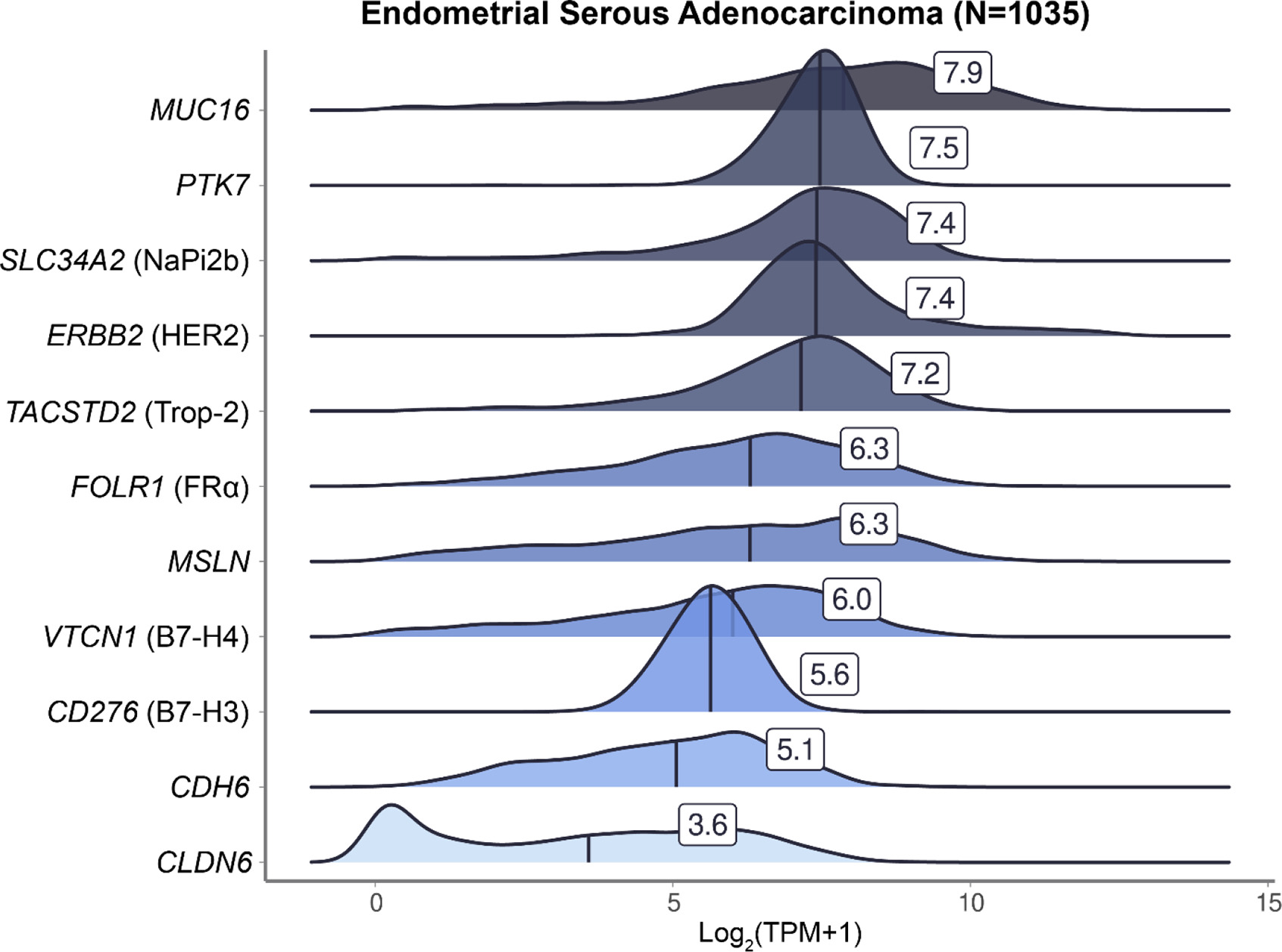
In uterine corpus endometrial carcinoma, MUC16 protein levels were 1.21-fold higher in tumor samples than in normal, adjacent tissue and showed a strong positive correlation with mRNA expression (Spearman’s ρ = 0.71). MUC16 mRNA expression was analyzed in tumors from 4349 patients. Median expression levels (log2[TPM + 1]) varied by histologic subtype, with the highest in serous adenocarcinoma (7.9) followed by endometrioid adenocarcinoma (7.3), and lowest in undifferentiated carcinoma (3.2; though the sample size was small). In serous adenocarcinoma (n = 1035), MUC16 was the most highly expressed gene with 1.4- to 3.7-fold higher expression than other therapeutic targets in development for endometrial cancer including ERBB2 (HER2) (1.4-fold), TACSTD2 (Trop-2) (1.6-fold), FOLR1 (FRα) (3-fold), and VTCN1 (B7-H4) (3.7-fold) (Figure). In serous adenocarcinoma, high median MUC16 expression was maintained across disease stages (7.6–8.3) and in primary vs metastatic tumors (7.4 vs 8.2).
Conclusions
MUC16 protein expression was higher in endometrial tumor tissue compared with normal, adjacent tissue, and showed a robust correlation with mRNA expression—underscoring its reliability as a cross-modal biomarker. MUC16 expression varied across endometrial cancer subtypes and was most highly expressed in serous adenocarcinoma and endometrioid adenocarcinoma. In serous adenocarcinoma, MUC16 expression was uniformly high irrespective of disease stage and showed the highest expression of known ADC targets in development. Collectively, these findings support MUC16 as a promising therapeutic target for further clinical investigation.