-
PROVIDERS
New MRD Medicare Coverage for Select Indications*
*When coverage criteria are met. Additional criteria and exceptions for coverage may apply.
-
LIFE SCIENCES
Register now
UPCOMING WEBINARTranslating data into an actionable R&D strategy
-
PATIENTS
It's About Time
View the Tempus vision.
- RESOURCES
-
ABOUT US
View Job Postings
We’re looking for people who can change the world.
- INVESTORS
10/14/2025
Lymphocyte Activation Gene-3 (LAG3) Expression Patterns and Immunotherapy (IO) Response in Metastatic Renal Cell Carcinoma (mRCC)
ESMO 2025
PRESENTATION
Authors
R.R. McKay, A.J. Dugan, U. Jariwala, K. Ronski, J. Mercer, E. Saad, J. El Masri, M. Machaalani, M.J. Saleh, C. Rose, S. Signoretti, D.A. Braun, S.K. Pal, T.K. Choueiri
Background – LAG3 is an immune checkpoint receptor that has gained interest as a response biomarker and treatment target. However, its relationship with outcomes in RCC is poorly characterized. This study evaluates LAG3 gene expression and its association with outcomes.
Methods – De-identified DNA-NGS data (xT) and RNA-NGS (xR) from patients (pts) with clear cell RCC (n=425) within the Tempus multi-modal database were analyzed using Lens. Eligible pts had first-line (1L) IO and biopsies collected within 1 year of IO. Samples were stratified into quartiles and median (high/low) by LAG3 RNA expression (TPM). Immune cell proportions (%) were estimated from RNA (quanTIseq). Real-world (rw) objective response rate (rwORR) was assessed within 90-days of IO. Rw overall survival (rwOS) was defined as the time from 1L IO start to death, lost to follow-up, or 5 years after 1L and analyzed using Cox proportional hazard models and p values (Wald test).
Results – The median age was 63 years and most pts were male (73%), white (79%), with metastases at specimen collection (94%). Prior nephrectomy (54%) was more common with highest LAG3 (p<0.004). BAP1 (p<0.001) and NF2 (p=0.002) were increased in the highest LAG3 groups, while VHL, PBMR1, and SETD2 were not. LAG3 correlated with higher CTLA4, PDL1, TIM3, TIGIT RNA expression (all p<0.001), and increased M1/M2 macrophages, NK, B, CD8 T, and Treg cell % (all p<0.001). Among pts treated with any 1L regimen, rwORR did not differ by LAG3 (p=0.20). When evaluating LAG3 high/low groups across 1L IO, low LAG3 associated with reduced rwORR and increased PD compared to high LAG3 (p=0.02) (Table). rwOS was similar across LAG3 groups.
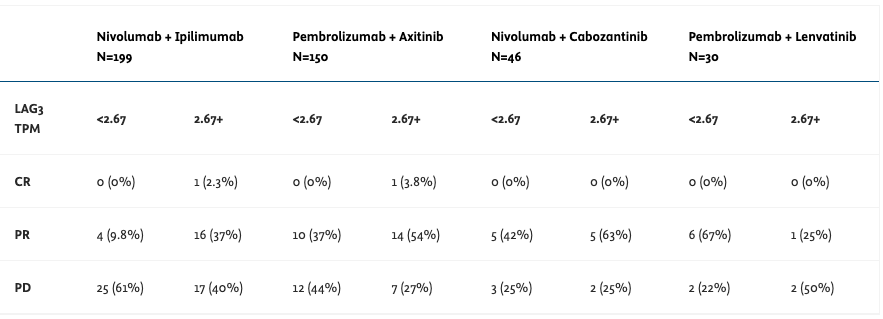
CR=complete response, PR=partial response, PD=progressive disease, TPM=Transcripts per million
Conclusions – LAG3 positively correlated with immune checkpoint gene expression and tumor immune cell proportions, indicating unique IO combinatorial strategies for pts with RCC may be warranted. The association of low LAG3 with a reduced initial response, suggests its potential utility as a marker for early IO response.