-
PROVIDERS
New MRD Medicare Coverage for Select Indications*
*When coverage criteria are met. Additional criteria and exceptions for coverage may apply.
-
LIFE SCIENCES
Register now
UPCOMING WEBINAR
Unlocking Foundation Models: Our experience from proof of concept to deploying at scale -
PATIENTS
It's About Time
View the Tempus vision.
- RESOURCES
-
ABOUT US
View Job Postings
We’re looking for people who can change the world.
- INVESTORS
01/04/2026
Artificial Intelligence in healthcare in 2026 and beyond
Tempus uses generative AI and LLM-powered tools to rapidly analyze large volumes of patient records and unstructured data, enabling users to build precise patient cohorts with natural language and generate insights in seconds.
Key Takeaways
- In a recent pilot, our AI-enabled abstraction processed 60,000 patient records in just a few days—a task that would have previously taken a large team of our abstractors months to complete.
- Lens users can now construct highly specific patient cohorts using natural language in seconds, even with massive datasets.
- The latest iteration of Tempus One includes four new breakthrough generative AI-powered capabilities that leverage LLMs to derive insights from unstructured data.
AI-enabled data abstraction transforms Tempus data
Tempus integrates advanced AI to augment data abstraction, increasing the speed and scale of data structuring to unlock novel insights from one of the world’s largest multimodal libraries. This hybrid approach is doing more than just increasing speed and scale; it’s unlocking the ability to answer novel research questions that were previously out of reach.
Our AI-enabled approach is transforming the landscape for life science researchers, and I’m excited to share how we are making it a reality. When we bring AI into the loop, it serves to augment and enable this human-led process. This “human-in-the-loop” framework ensures that even as we scale, our commitment to data quality and accuracy remains our central focus. In a recent pilot, our AI-enabled abstraction processed 60,000 patient records in just a few days—a task that would have previously taken a large team of our abstractors months to complete.
Learn how Tempus’ AI engine transforms unstructured clinical text into analysis-ready real-world data.
Advancing the frontier of AI in healthcare
Today, Tempus has approximately 38 million research records, including longitudinal follow-up results, and over 7 billion clinical notes. The promise of healthcare-specific foundation models is already being realized.
Recent research from NYU shows that models trained exclusively on healthcare data are outperforming general-purpose models like ChatGPT on clinical tasks. As we continue to expand our data assets and refine our models, we believe Tempus will set the standard for what’s possible in healthcare AI, including: Designing better clinical trials Pivoting patient population for investigational drugs
Harnessing generative AI to refine clinical research & drug development
Lens is a purpose-built platform designed to facilitate the rapid generation of insights from Tempus’ multimodal data library of over 8M research records. The platform revolutionizes the way researchers leverage real-world data (RWD) with the integration of Tempus One, a powerful generative AI assistant that provides access to patient insights.
Lens users can now construct highly specific patient cohorts using natural language in seconds, even with massive datasets. “Tempus’s AI tools within Lens have significantly accelerated my research, enabling me to identify distinct patient subsets much faster than traditional methods.” “Generative AI now allows us to extract diverse features from unstructured text, maximizing information analysis.” “Through client collaborations, we’ve identified three key applications: identifying patients with rare cancers or complex clinical features, enriching data with previously uncurated features directly from unstructured data, and enabling detailed analysis of individual patients or small cohorts.”
How AI-driven solutions are helping close care gaps in precision medicine adoption
AI helps streamline the process and get the right information to physicians as soon as a therapy or biomarker becomes relevant. It is important to remember that gaps in care are not always knowledge gaps; they can often be operational gaps within a health system.
In this way, an AI tool integrated into the electronic health record (EHR) can act as a safety net. This “triple win” can be thought of as benefiting three Ps: the patient, the provider, and the pharma industry.
A great example is the ESR1 mutation in metastatic breast cancer, which is an emerging mutation that develops after a patient starts endocrine therapy and can be difficult to identify at the right time in a patient’s journey.
How cutting-edge technologies are helping to advance precision medicine
We’ve developed an in-house version of Tempus One using an agentic workflow platform that we call “Agent Builder.” One example is our Publications Agent, which sifts through our extensive collection of publications to quickly retrieve information such as authors, conference details, and publication dates.
The goal of Lens is to simplify the process of stratifying patient cohorts, making it as straightforward and swift as possible. This rapid turnaround is transformative for researchers who can move from hypothesis to sizing a cohort of interest almost instantaneously.
Navigating the evolving landscape of breast cancer care using AI
Guidelines recommend testing for ESR1 mutations on a specimen obtained after progression on endocrine therapy and to consider testing at subsequent progression events. Tempus Next provides near real-time alerts to clinicians, identifying patients who may have fallen off care guidelines, as well as feedback to help institutions understand trends in their patient population.
Solving cancer’s tissue scarcity problem: How Tempus uses AI models in pathology to transform tissue analysis
At Tempus, we’ve developed Paige Predict, an AI system that analyzes digitized images of H&E-stained pathology slides to predict nucleic acid yield with unprecedented accuracy. Paige Predict enables significant tissue conservation by identifying samples with a higher TNA [total nucleic acid] yield than is typical, allowing fewer slides from that specimen to be used for NGS testing and ensuring more tissue is preserved for other critical downstream biomarker tests.
These “quantity-not-sufficient” (QNS) failures create a clinically challenging cascade: patients endure additional invasive procedures and treatment decisions can be delayed by weeks, resulting in wasted time and resources.
Across the validation set, Paige Predict demonstrated the likelihood of a sample failing Tempus xT sequencing with 96% specificity. In our validation studies, samples flagged by the model as likely to fail either DNA or RNA sequencing had a PPV of 80%.
Tempus Announces the Launch of Paige Predict
Leveraging Tempus and Paige’s intelligent digital pathology platform and proprietary AI products, Paige Predict identifies critical biomarker information from even scarce amounts of tissue and analyzes H&E images to predict the likelihood of 123 biomarkers and oncogenic molecular pathways in 16 cancer types, including NSCLC, prostate, breast, pancreatic, colorectal, and more.
“Tissue can be scarce, but insights don’t have to be,” said Ezra Cohen, MD, Chief Medical Officer, Oncology at Tempus.
Tempus One Introduces New GenAI Capabilities to Query Millions of Unstructured Documents for Research and Clinical Care
The latest iteration of Tempus One includes four new breakthrough generative AI-powered capabilities that leverage LLMs to derive insights from unstructured data.
Patient Query : Identifying and enrolling patients into clinical trials continues to be one of healthcare’s biggest challenges. This agent can tap into unstructured data, such as progress notes, pathology reports, and imaging scans, which are important to understanding if a patient may be eligible for a trial.
Patient Timeline : Every patient’s journey is unique. Using an LLM-based data science model, Tempus One turns digital health records into a structured timeline of clinical events, featuring diagnostic results, changes in treatment, and more.
Prior Authorization : Drafting and submitting prior authorization forms can require hours of administrative work for care teams, an arduous but necessary process to ensure that patients receive coverage for specific treatments throughout their care journey. Now, a new agent inside of Hub, Tempus’ provider platform, helps clinicians gather pertinent guidelines, drug labels, payer policy, and other relevant patient information, and outputs support documents tailored to each patient’s case for further use by their care team.
Data Exploration : For the first time, researchers are able to ask questions and receive answers that are derived from both Tempus’ de-identified curated datasets and unstructured data housed within Lens, the company’s data analytics platform.
Northwestern Medicine Becomes First Health System to Integrate Tempus’ Generative AI Co-Pilot, David, into its EHR Platform
Northwestern Medicine and Tempus AI, Inc. (NASDAQ: TEM) today announced a notable expansion of their longstanding collaboration. Northwestern Medicine will be the first health system to integrate David, Tempus’ generative-AI clinical co-pilot, within its electronic health record (EHR) platform for its clinical care team. The expanded collaboration marks a new chapter in the organizations’ shared commitment to harnessing data and AI to advance patient care. Northwestern Medicine and Tempus clinical, operations, and technical teams are working together to customize the platform to specifically address the health system’s needs.
Through the integration of David, Northwestern Medicine will adopt core parts of Tempus’ AI infrastructure to allow its AI applications to be underpinned by a multimodal patient record and to co-develop, deploy, and real-time monitor novel AI algorithms and agents into the David experience. Deploying David directly into the EHR empowers Northwestern Medicine’s clinical teams with real-time, AI-enabled insights at every point of care, all in an effort to streamline complex treatment decisions, reduce administrative burden, and ultimately improve patient outcomes.
- With this integration, clinical teams will be able to:
- Build custom AI agents tailored to Northwestern Medicine’s unique workflows, further enhancing efficiency and care quality.
- Query patient data across the EHR using natural language, surfacing relevant information in seconds.
- Automate pre-appointment preparation, with AI-generated patient summaries and treatment histories.
- Receive real-time support during appointments, including intelligent note-taking and key information highlights.
- Streamline post-appointment tasks, such as documentation, treatment planning, prior authorizations, and clinical trial matching.
“Northwestern Medicine was our first genomic sequencing partner almost ten years ago, and together we led the field into generating multimodal data at scale. A decade later, we are now embarking on a new chapter that will demonstrate how generative AI can transform the way healthcare is delivered,” said Eric Lekfofsky, Founder and CEO at Tempus. The integration of David into Northwestern Medicine’s EHR is a major step forward in our mission to connect multiple data modalities and deliver actionable insights in real time.
Tempus Announces Collaboration with Median Technologies to Integrate AI-Powered Lung Cancer Screening into the Pixel Platform
Tempus AI, Inc. (NASDAQ: TEM), a technology company leading the adoption of AI to advance precision medicine, today announced a collaboration with Median Technologies (EPA: ALMDT) to bring Median’s proprietary eyonis® LCS to the Tempus Pixel platform. Closing the gap and achieving full participation among eligible individuals could prevent an estimated 62,110 lung cancer deaths over five years. eyonis® LCS is an AI-based CADe/CADx software as a medical device (SaMD) for lung cancer screening.
Through this collaboration, Tempus will integrate eyonis® LCS into Tempus Pixel 1, an FDA-cleared, CE-marked AI-enabled solution that provides advanced analysis, tools, and automated reporting from radiology images to help providers accurately track and quantify lesions. The integration of eyonis® LCS will enable non-invasive characterization of CT identified lung nodules at the time of nodule detection with its proprietary nodule malignancy score, a feature that will allow clinical teams to stratify and prioritize patients in lung cancer screening programs. By expanding our Pixel platform with sophisticated lung cancer screening AI tools, we are enabling radiologists to manage complex caseloads while prioritizing early-stage detection.
In 2022, Tempus acquired Arterys, incorporating its AI-driven imaging tools—ranging from lung CTs and chest X-rays to cardiac MRIs—into the Tempus ecosystem. This was followed by the acquisition of Paige, which contributed a proprietary dataset of almost 7 million clinically annotated, de-identified pathology slides to further accelerate Tempus’ efforts.
Tempus Announces Strategic Collaboration Agreement with Merck to Accelerate AI-Driven Precision Medicine
Tempus AI, Inc. (NASDAQ: TEM), a technology company leading the adoption of AI to advance precision medicine, and Merck, known as MSD outside of the United States and Canada, today announced an expanded, multi-year collaboration aimed at accelerating the discovery and development of precision medicine biomarkers and supporting Merck’s oncology and potentially broader therapeutic portfolios. This collaboration builds on our existing relationship and reflects our shared commitment to harnessing the power of multimodal datasets with AI to deliver better options for patients. We’ve spent years configuring our Lens Platform to seamlessly leverage our library of de-identified multimodal data with the necessary AI computing power to train and fine-tune specific models for healthcare.
Under the terms of the agreement, Merck will use Tempus’ de-identified data along with Tempus’ Lens Platform and Workspaces environment, which offers an advanced computational configuration powered by one of the industry’s largest GPU infrastructures, which enables researchers to efficiently conduct complex analyses on training-ready multimodal datasets, generating novel insights to accelerate the development and optimization of candidate therapies at scale. This collaboration with Tempus positions Merck to advance our precision oncology strategy through the application of the latest AI/ML capabilities to discover novel precision biomarkers, identify mechanisms of cancer cell resistance, and inform rational combinations for drugs in our early pipeline.
-
 03/30/2026
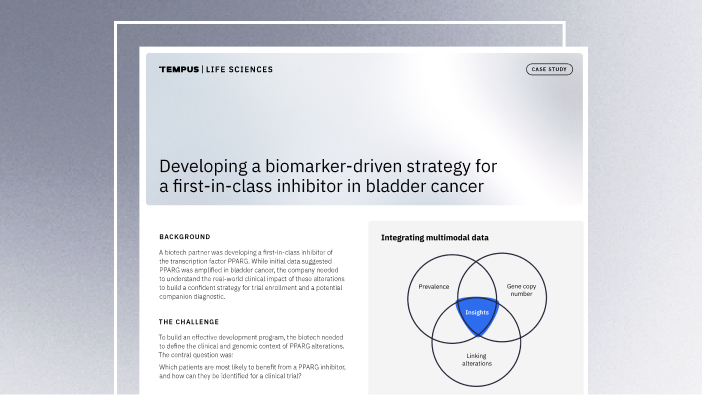
Biomarker strategy for an inhibitor in bladder cancer
Discover how Tempus’ multimodal data analysis helped a biotech partner identify a key biomarker in bladder cancer. This data-driven strategy de-risked clinical development and supported a successful $100 million financing round.
Read more -
 03/27/2026
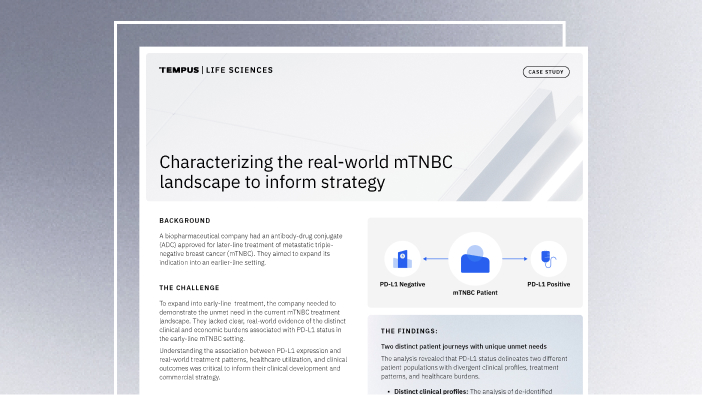
Characterizing the real-world mTNBC landscape to inform strategy
Learn how Tempus’ analysis of multimodal real-world data helped a biopharmaceutical company identify distinct patient journeys and healthcare burdens in mTNBC based on PD-L1 status, enabling them to refine their clinical and commercial strategy.
Read more -
 03/24/2026
Translating data into an actionable R&D strategy
Hear from industry leaders about how a data-driven understanding of disease biology informs critical decisions and accelerates therapeutic development. Secure your recording now.
Watch replay