-
PROVIDERS
New MRD Medicare Coverage for Select Indications*
*When coverage criteria are met. Additional criteria and exceptions for coverage may apply.
-
LIFE SCIENCES
Read now
Accelerating a phase 1 oncology trial: The TIME Network's impact on patient enrollment
-
PATIENTS
It's About Time
View the Tempus vision.
- RESOURCES
-
ABOUT US
View Job Postings
We’re looking for people who can change the world.
- INVESTORS
01/27/2026
Beyond the blueprint: A scientific deep dive on RNA’s role in ADC strategy
In this scientific deep dive, Joshua Bell, PhD, Life Sciences Divisional Vice President, explains why whole-transcriptome data is an important layer for understanding tumor biology and supporting research into the next generation of antibody drug conjugates.
Authors
Joshua SK Bell, PhD
Divisional Vice President, Life Sciences

Divisional Vice President, Life Sciences
The rise of antibody-drug conjugates (ADCs) has marked a significant advancement in oncology, creating an urgent need for more sophisticated diagnostic strategies. While modern companion diagnostics (CDx) require clear business and regulatory pillars, their success is built on a powerful technical foundation.
Here, Joshua Bell, Tempus’ Life Sciences Divisional Vice President, explores that foundation. Beyond identifying altered expression programs in tumors not measurable by DNA sequencing, Josh explains why whole-transcriptome data is the most critical and actionable layer for designing the next generation of ADCs.
The power of real-world transcriptomic dataBiopharma companies often perform RNA-seq on their own clinical trial samples. Why is a large-scale, real-world dataset like Tempus’ still critical for ADC development? |
| Joshua Bell: It is crucial for companies to perform RNA-seq on their clinical trial samples. For novel therapies, sequencing trial samples is the only way to determine how well any RNA-based biomarker predicts response. However, our large-scale dataset provides valuable context before a trial begins. To understand the landscape of target antigen expression and other biomarkers of ADC response and to inform trial planning, access to large-scale data can be beneficial. Our library of ~350,000 whole transcriptome profiles comes from late-stage, metastatic, and often heavily pre-treated patients. This is critical because tumor biology can change dramatically in these later lines of therapy, and our data allows researchers to investigate antigen expression in specific clinical settings, including later-stage disease, which may not be represented in public datasets. Sequencing of trial samples can then be used to refine antigen-overexpression thresholds, train signatures of response, and identify other predictive biomarkers that can be leveraged in later trial phases or projected onto the Tempus database to inform indication expansion. |
Modeling therapeutic resistance is a major challenge in drug development. How does Tempus’ real-world data library help researchers understand ADC response and failure? |
| Joshua Bell: We have data from thousands of patients treated with other ADCs, which allows us to look at the importance of antigen expression and develop payload sensitivity models. Because it is all paired with clinical data, we can analyze how a sample’s expression or payload sensitivity has changed after failing a different ADC. We can also use the pre-treatment samples to identify what would have predicted an initial response or resistance. |
Building a better biomarker: From single targets to complex signaturesADC development has traditionally relied on protein-based assays like IHC. What are the limitations of that approach, and what advantages does whole-transcriptome sequencing offer? |
| Joshua Bell: An IHC test gives you a single, static data point. ADC response, however, is driven by a complex interplay of factors, including antigen expression, payload sensitivity, and the immune microenvironment, among others. Our full transcriptome RNA sequencing captures the expression of over 19,000 genes, giving you a much broader picture of the tumor’s biology. Additionally, as more and more antibody-based therapies are approved with IHC CDx, tissue samples may be exhausted before all indicated IHCs can be performed. It will become intractable to screen each patient for each possible therapy, but RNA-Seq measures the whole transcriptome from a single sample in addition to providing critical fusion detection. |
For complex biomarkers like HER2-low, how do Tempus’ proprietary algorithms use whole-transcriptome data to assess functional target expression? |
| Joshua Bell: The “HER2-low” category exists because of the limitations of immunohistochemistry (IHC), a test designed decades ago to identify only the highest levels of HER2 expression for predicting response to trastuzumab without a drug conjugate. While antibody-drug conjugates (ADCs) like trastuzumab-deruxctecan have been shown to require less target expression to be effective than the antibody alone, the field often still relies on this older method. In contrast, our RNA sequencing data provides a clean, continuous range of expression. Our analyses suggest that quantitative RNA data may provide additional insights into patient response to ADCs compared to the semi-quantitative bins provided by IHC. |
RNA degradation is a concern with real-world samples. What quality control metrics does Tempus use to ensure its RNA data is reliable for development? |
| Joshua Bell: We have very extensive quality control at every step. As part of our standard workflow, we create a high-resolution digital image of the H&E-stained slide for every tissue sample. Before extraction, our algorithms use this digital image to predict the likelihood of success. During extraction and library prep, QC steps measure fragment length and concentration. After sequencing, our assay includes unique molecular identifier (UMI) adapters so we can de-duplicate the data, which is critical for quality. Most importantly, we monitor every RNA-seq flow cell by including a universal human reference (UHR) control. An algorithm checks that the UHR is comparable to previous UHRs, supporting detection and control for potential batch effects. Other controls are also included to ensure that expected fusions are detected. |
The vision for a scalable, software-driven CDx platformWhat is the ultimate vision for a platform CDx for ADCs? |
| Joshua Bell: The ultimate vision is a single, universal assay that can serve as the companion diagnostic for a wide range of ADCs, both now and in the future. Our whole-transcriptome RNA sequencing assay provides a foundation for research into platform CDx approaches. Because the assay captures gene expression across the transcriptome, new biomarkers can be evaluated using software-based algorithms. Instead, a new biomarker—whether it’s a single antigen expression or a complex transcriptional signature—is deployed as a software-based algorithm on top of our validated diagnostic backbone. This approach provides a much more efficient and scalable path to market from both a technical and commercial perspective. |
From data to clinical impactHow is Tempus’ data being used in practice to help partners accelerate their clinical trials? |
| Joshua Bell: For partners choosing to enroll on IHC, a common challenge is a large screen-fail rate. Because so many patients already have our RNA-seq assay performed, we can identify individuals with high expression who are very likely to be positive by IHC. By leveraging our TIME clinical trial network, we can direct those patients to trial sites. In one study, this approach supported patient enrollment in 8 months, compared to the anticipated 12 to 18 months. Other partners have found difficulty in developing a robust IHC assay, or have chosen to adopt RNA in lieu of IHC given the substantial benefits. |
How are you translating RNA signatures into predictive algorithms that can be used in the clinic? |
| Joshua Bell: Tempus is committed to developing machine learning signatures to support research and clinical trial enrollment. For example, our suite of IHC prediction algorithms uses RNA sequencing data to estimate the likelihood of a positive IHC result for key ADC targets, such as HER2, TROP2, and Nectin-4. This approach may help identify potential candidates for clinical trials and support tissue preservation. Beyond IHC prediction, we have developed a portfolio of four transcriptional signatures: Tumor Origin (TO), HRD, IPS, and PurIST. The clinical adoption is significant, as 30% of our tissue orders now include an add-on algorithmic diagnostic test like HRD or TO. We are committed to continuing to develop signatures to better predict response to many therapies, including ADCs. |
The next wave of RNA innovationBeyond initial response, how does your data help researchers understand the mechanisms of acquired resistance to ADCs? |
| Joshua Bell: We can use both paired pre- and post-treatment biopsies and population-level comparisons to get good information about resistance. In general, we see that resistance can sometimes be linked to lower expression of the antigen, but often the resistance is due to payload sensitivity or other factors. We have success in developing machine learning signatures that use the whole transcriptome as training data to predict that. Understanding mechanisms of resistance to approved ADCs can inform how effective their ADCs may be in a post-treatment setting (e.g. if they share a target or payload) or provide a framework to understand resistance to their novel ADCs. |
DNA is often described as the cell’s blueprint. Why is RNA the more critical data layer for designing and deploying the next generation of ADCs? |
| Joshua Bell: For ADCs in particular, high antigen expression is typically the key, and this is generally not caused by a change in DNA. For example, Trop-2 is a very successful ADC target, and we very rarely see DNA alterations that explain its overexpression. The same is true for Nectin-4; the high expression is typically driven by epigenetic changes, which are reflected in the RNA but not in the DNA sequence. Even for ADC targets that commonly display amplifications in DNA like MET and HER2 (ERBB2), we observe many patients with high expression without amplification. Cancers evolve and become resistant to therapy largely through these epigenetic changes. RNA captures this active, functional state of the tumor. |
|
“While DNA provides the foundational blueprint, RNA tells you what the cancer is actually doing right now.” – Joshua Bell, PhD, Life Sciences Divisional Vice President |
By integrating comprehensive RNA-seq data with real-world clinical context, Tempus is building infrastructure to support research across the ADC lifecycle. This data-driven approach aims to make drug development more efficient and support efforts to reach patients who may benefit from these therapies.
| To learn more about how Tempus can support your ADC development program, contact us today. |
-
 04/03/2026
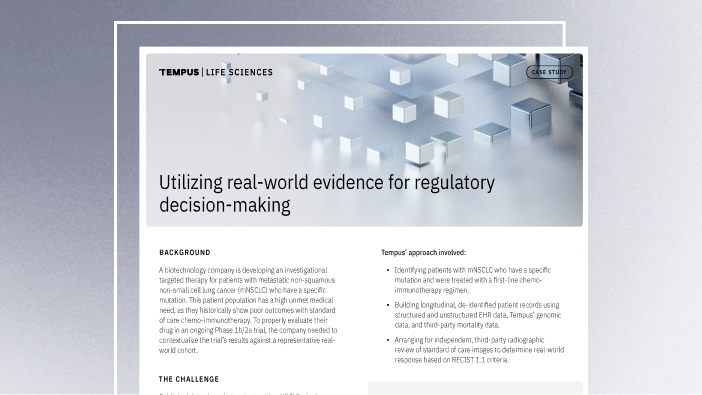
Utilizing real-world external controls for regulatory decision-making
A biotech company needed to contextualize its Phase 1b/2a trial for mNSCLC patients with a specific mutation. Learn how Tempus constructed a real-world external control arm to provide a benchmark for their regulatory submission.
Read more -
 03/30/2026
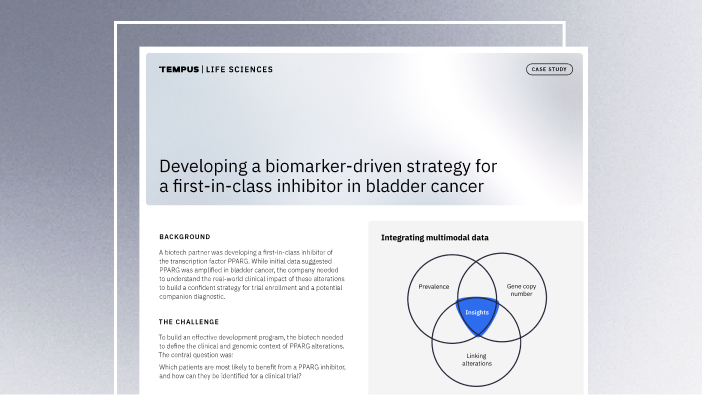
Biomarker strategy for an inhibitor in bladder cancer
Discover how Tempus’ multimodal data analysis helped a biotech partner identify a key biomarker in bladder cancer. This data-driven strategy de-risked clinical development and supported a successful $100 million financing round.
Read more -
 03/27/2026
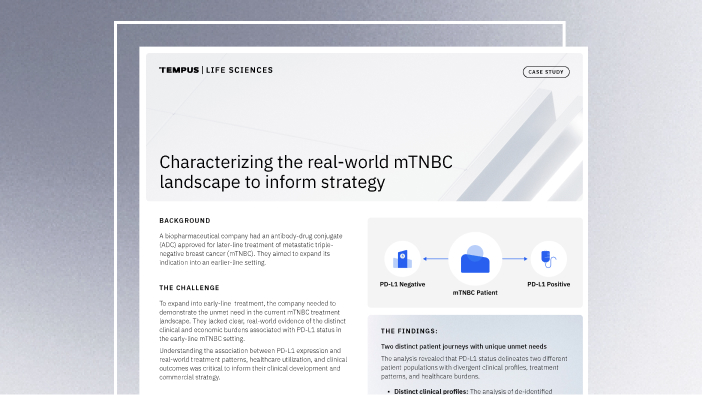
Characterizing the real-world mTNBC landscape to inform strategy
Learn how Tempus’ analysis of multimodal real-world data helped a biopharmaceutical company identify distinct patient journeys and healthcare burdens in mTNBC based on PD-L1 status, enabling them to refine their clinical and commercial strategy.
Read more