-
PROVIDERS
New MRD Medicare Coverage for Select Indications*
*When coverage criteria are met. Additional criteria and exceptions for coverage may apply.
-
LIFE SCIENCES
Register now
UPCOMING WEBINAR
Unlocking Foundation Models: Our experience from proof of concept to deploying at scale -
PATIENTS
It's About Time
View the Tempus vision.
- RESOURCES
-
ABOUT US
View Job Postings
We’re looking for people who can change the world.
- INVESTORS
01/04/2026
How AI is impacting the clinical trial process
Tempus’ Patient Query helps identify the right clinical trial patients more efficiently by filtering out many ineligible candidates and increasing potential matches after RN review, delivering highly accurate results that improve patient identification and pre-screening.
Key Takeaways
- Patient Query screened out ~72% of ineligible patients helping find the right patients more efficiently
- Tempus saw a 27.31% increase in the number of patients identified as a potential match for a given trial following a registered nurse (RN) review when using Patient Query, directly improving the efficiency of patient identification and pre-screening.
- Out of a total of 196 queries reviewed, the overall accuracy across all queries was 94.39%, with individual query accuracies ranging from 84.62% to 100.00%.
A new data-driven playbook for improving ADC success rates
ADCs hold immense promise but face significant development hurdles, from patient selection to acquired resistance. A platform combining multimodal RWD, AI-driven biomarker discovery, and PDOs can de-risk the entire ADC lifecycle and improve PTS. Three key challenges contribute to these late-stage setbacks
- Precise patient selection
- Understanding mechanisms of resistance
- Predicting response heterogeneity:
Real-world data allows researchers to move beyond single-biomarker hypotheses. For example, by analyzing TROP2 expression across a large set of de-identified patient profiles, researchers can explore potential indications for anti-TROP2 ADCs. RNA sequencing provides a quantitative measure of gene expression, which may offer additional insights for patient stratification compared to immunohistochemistry (IHC).
Enrolling patients in ADC trials can be a significant bottleneck, especially when eligibility depends on a novel or hard-to-access test. We help solve this challenge through just-in-time clinical trial matching. By applying AI models to Tempus xR whole-transcriptome data, we developed and validated unique algorithmic models to predict a patient’s likelihood of having a positive IHC result for key biomarkers, including HER2, TROP2, and Nectin-4, thereby facilitating potential clinical trial enrollment.
From fragmentation to integration: How AI-powered site networks are powering clinical research
While our understanding of cancer biology deepens, the operational framework for testing new therapies—the clinical trial—often remains a bottleneck. Identifying and enrolling eligible patients can be slow and inefficient, research teams are often stretched thin, and fragmented workflows can create administrative burdens that hinder research operations. The patient identification bottleneck:
The success of any trial hinges on enrolling the right patients, yet this remains one of the most significant challenges. Critical patient data, including biomarker results, is often buried in unstructured formats like clinical notes or pathology reports or not completed at the right time in the patient’s journey, making it difficult to surface eligible candidates in a timely manner. Smart site networks that harness artificial intelligence (AI), multimodal data, and collaboration can help create a more efficient and sustainable model for clinical research.
Our network leverages advanced AI, including natural language processing (NLP) and large language models (LLMs), to analyze both structured and unstructured data from the electronic medical record (EMR), medical imaging reports, lab results and genomic information to support rapid and accurate patient identification. The platform can extract information such as biomarker status and disease characteristics from clinical notes, labs, and genomic reports, supporting accurate patient identification regardless of next-generation sequencing vendor. Through our Just-in-Time (JIT) activation model, sites can open a trial in as little as 10 days once an eligible patient is identified.
Improving patient matching efficiency with an AI-powered platform
An AI-powered screening tool helped increase trial matching efficiency by identifying the right patients for review, screening out ~72% of ineligible patients from the initial pool. The manual review of patient records is time-consuming and difficult to scale, especially when critical information is buried in unstructured data like clinical notes.
Tempus deployed an AI agent called Patient Query to address this challenge. Patient Query functions as an intelligent agent that automates the labor-intensive step of patient evaluation by allowing users to easily gain insights from unstructured data across patient records at scale.
Across 8 trials using the tool for at least 30 days, we evaluated 9,875 patients. For the 8 trials assessed, the tool appropriately screened out ~72% of patients that are not currently eligible from the initial pool.
Out of a total of 196 queries reviewed, the overall accuracy across all queries was 94.39%, with individual query accuracies ranging from 84.62% to 100.00%.
Key initial results
- Patient Query screened out ~72% of ineligible patients helping find the right patients more efficiently
- Tempus saw a 27.31% increase in the number of patients identified as a potential match for a given trial following a registered nurse (RN) review when using Patient Query, directly improving the efficiency of patient identification and pre-screening.
How Tempus applies AI for clinical research and patient care
The session explored how Tempus operationalizes a data-driven flywheel—from aggregating multimodal patient information to applying a sophisticated artificial intelligence engine and delivering insights that support clinicians and researchers. There are three components of the Tempus platform that are foundational to our software suite.
The first pillar involves aggregating multimodal patient information from different sources, including electronic health records (EHR), laboratory information systems, image management systems, and picture archiving and communication systems.
The second pillar focuses on analyzing the aggregated datasets.
The third pillar centers on delivering those insights to clinicians at the point of decision-making.
Tempus Hub serves as the physician’s interface, integrating these insights directly into their workflow through reports and other clinical decision-support tools. Tempus Link and Next platforms also employ data analysis methodologies to support clinical decision-making. Both Link and Next utilize algorithms to analyze de-identified data in a continuous, surveillance-like manner, identifying patients who may be eligible for a clinical trial.
Clinical trial inclusion and exclusion criteria are often complex and require information from unstructured clinical notes, and as such, these tools are designed to process unstructured data in near real-time and surface potential candidates for treatment. Additionally, Tempus Next codifies clinical care guidelines and monitors patient care to identify when an individual has deviated from guideline-directed care.
Tempus One’s ability to query unstructured data is critical for gaining a comprehensive understanding of a patient’s clinical context and determining their eligibility for a trial. This work is supported by Tempus’ extensive library, which includes approximately 300 petabytes of multimodal data.
Implementing successful decentralized oncology trials
This hub-and-spoke model allows us to centralize principal investigator (PI) expertise. For trials targeting exceptionally rare mutations, like NRG1 fusions, we use a single-site model to cover the entire state, ensuring we don’t miss any eligible patients. We started our DCT model with prospective real-world evidence (RWE) and Phase 4 studies, which are less operationally complex.
We use our internal data warehouse for pre-screening, deploy eConsent to enroll patients from any of our practices, and have a central team for data entry. We launched a fully national, decentralized trial for pancreatic cancer patients with a rare FGFR mutation.
Precision patient identification supports our network sites in growing their research programs, facilitating broader trial access for patients, and improving site operations.
Tempus Compass | Real-World Data Insights for Life Sciences
Tempus Compass brings end-to-end solutions across phase I-IV of therapeutic development. From discovery research, trial design, and patient enrollment to regulatory approval and post approvals, Compass is a full-service partner that can tailor solutions to any step of your oncology drug development cycle.
Accelerate your clinical trials with unparalleled access to real-world data, intelligent site selection, and unique enrollment solutions. Compass offers full-service, scalable solutions from Phase I to Phase IV global trial management including trial feasibility and planning and site identification and selection.
Our expertise is across a range of oncology treatment modalities and all trial designs including Modern trial designs (basket, umbrella, etc.).
Accelerating a phase 1 oncology trial: The TIME Network’s impact on patient enrollment
This case study highlights how sponsors like Pathos AI are leveraging the Tempus TIME Trial Network to launch Phase 1 studies more efficiently, reaching critical milestones faster. Pathos AI, an AI-driven drug development company, is developing Pocenbrodib, a novel CBP/p300 inhibitor. Of the 10 patients enrolled on this trial to date, Tempus helped identify 6 matches through the TIME network
- 762 screened
- 88 matches
- 6 consents
- 6 enrollments
Tempus’ platform helped identify sites with access to a high volume of potentially eligible patients, and the network’s streamlined infrastructure enabled rapid activation.
Validating a novel target and informing trial design for a first-in-class therapeutic
Tempus analyzed its de-identified multimodal data to assess the prevalence of the target mutation-HLA signature across a wide range of solid tumors. This analysis supported the company’s indication prioritization and patient segment mapping. Confirm the prevalence of the target mutation-HLA signature in key indications, including colorectal, gastroesophageal, pancreatic, ovarian, and lung cancer. Inform the design of a tumor-agnostic Phase 1 basket study by identifying cohorts with a higher prevalence of the target mutation-HLA signature.
Clinical Trial Matching for Oncology
Tempus TIME powers smart sites creating a network designed to support and accelerate clinical development. Experience faster trial activation, accurate patient matching, enhanced resource utilization, and the power of a unified approach to advance your research goals and bring innovative treatments to patients sooner. Just-in-Time model is designed to support efficient site activation in as little as a few days. Intuitive, automated tools that reduce manual workload and empower researchers to do more. Harness our advanced trial matching services–combining large language models, machine learning, and clinical insight–with a clinical team of experts pre-screening the matched patients and presenting potentially eligible patients with a white-glove service to each site. 100 sites representing 1,000+ clinical locations. 1.5k+ clinical trials have been active. 2k+ patients consented into our trials.
On average, TIME completes trial onboarding in 10 weeks or less before activating sites in as little as a few days with our Just-in-Time site activation model. Generative AI scans structured and unstructured clinical notes, enhancing identification of patients who may be eligible for trial participation.
Optimizing Clinical Trial Subject Selection: Insights from Exigent Research Network and the Tempus AI TIME Program Collaboration
The Tempus AI TIME Program is a robust collection of clinical trial solutions including an AI-powered clinical trial matching software (TApp), a team of oncology screening nurses, a rapid trial activation process, and a patient portal for tracking identified trial matches. The TApp is a Tempus AI clinical trial matching platform that utilizes patient data, trial eligibility criteria, and natural language processing (NLP) models to execute a daily algorithmic matching of subjects to trials. Potential matches identified by the TApp were reviewed by the Tempus AI nursing team, and if confirmed, sent to the Exigent site via the LINK portal.
Between January 1, 2022 and December 31, 2023, a total of 244,986 patients from Exigent’s 16 sites were screened by the TApp against the 189 clinical trials in the TIME portfolio. There were 3,179,079 changes to individual patient records and 2152 trial updates, which resulted in 216,712,093 unique TApp searches. Tempus AI nurses reviewed 33,083 matches and passed 6040 patients to sites for interventional trials and 1312 patients for observational studies. There were 71 trial activations resulting in 312 patient consents (169 observational, 143 interventional).
The average duration for study activation was 12.3 days for a JIT activation and 33.8 days for a prospective activation. During a 2-year period, 216M+ unique TApp searches occurred, which resulted in over 310 consents with rapid activation times.
Tempus TIME Network Expands Support of Phase I Clinical Trials To Accelerate Activation and Enrollment
To further expand its support of phase I trials, Tempus has formed the TIME Precision Network, a group of investigators leading the phase I study platform with a focus on activating and enrolling quickly across over 40 phase I-capable research centers. At the Taylor Cancer Research Center (TCRC), Tempus activated the site in approximately two weeks for the Nimbus 9216-101 study, and enrolled its first patient within one month of site activation.
For the Pathos P300-02-001 study, Tempus screened and enrolled the trial’s first and second patients at Nebraska Cancer Specialists and Oncology Consultants within weeks. “The integration of phase I clinical trial sites adds a critical capability to the TIME Network. We are now able to activate and efficiently execute these early studies that are fundamental to drug development and such a valuable offering to patients.” said Ezra Cohen, MD, Chief Medical Officer, Oncology at Tempus. “Through the relationship of our community oncology, not-for-profit program and Tempus, a seamless process has been established to implement study activation and rapidly engage patient start up.
As an example, we were the first to safely administer a novel WRN inhibitor by Nimbus within a global trial to a cancer patient. Additional patients have been evaluated and are now proceeding with the enrollment process.” stated John Nemunaitis, Chief Scientific Officer, Taylor Cancer Research Center.
Tempus | DCT Webinar
Learn how hybrid decentralized trials have been successfully launched by some of the largest research organizations in the nation. Hear how TIME is expanding the model and adding its AI-enabled patient matching to create enrollment success. Hear about patient journeys supported by DCTs that allow the patient to receive care closer to home and ease the burden of research on them and sites. Jessica Bivins, MPH serves as VP of Research at OneOncology, where she leads the organization’s research site management arm, OneR. Dr. Paulson serves as the co-director of the Gastrointestinal Research Program for The US Oncology Network, as well as the medical director for the Neuroendocrine Research and Treatment Center at Baylor Charles A. Sammons Cancer Center. Dr. Roychowdhury is currently Professor (tenure track) of medical oncology at the Comprehensive Cancer Center and the James Cancer Hospital at The Ohio State University. His research focuses on precision cancer medicine combining genomics, computer science, novel diagnostics, biology, and clinical trials. Noelle Gaskill, MBA, ACRP-CP serves as the VP, GM of the TIME Network for Tempus.
-
 03/30/2026
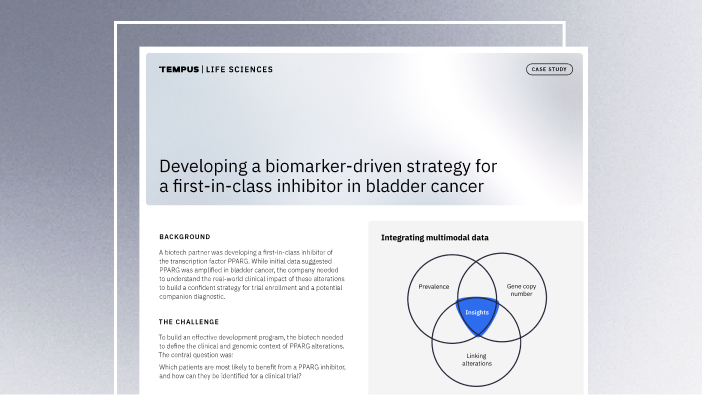
Biomarker strategy for an inhibitor in bladder cancer
Discover how Tempus’ multimodal data analysis helped a biotech partner identify a key biomarker in bladder cancer. This data-driven strategy de-risked clinical development and supported a successful $100 million financing round.
Read more -
 03/27/2026
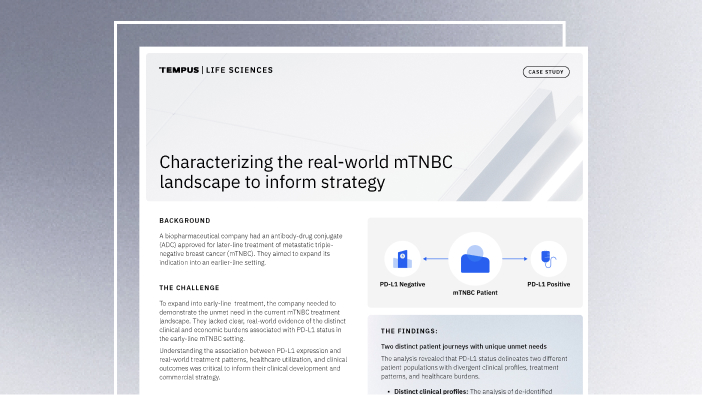
Characterizing the real-world mTNBC landscape to inform strategy
Learn how Tempus’ analysis of multimodal real-world data helped a biopharmaceutical company identify distinct patient journeys and healthcare burdens in mTNBC based on PD-L1 status, enabling them to refine their clinical and commercial strategy.
Read more -
 03/24/2026
Translating data into an actionable R&D strategy
Hear from industry leaders about how a data-driven understanding of disease biology informs critical decisions and accelerates therapeutic development. Secure your recording now.
Watch replay