-
PROVIDERS
New MRD Medicare Coverage for Select Indications*
*When coverage criteria are met. Additional criteria and exceptions for coverage may apply.
-
LIFE SCIENCES
Register now
UPCOMING WEBINAR
Unlocking Foundation Models: Our experience from proof of concept to deploying at scale -
PATIENTS
It's About Time
View the Tempus vision.
- RESOURCES
-
ABOUT US
View Job Postings
We’re looking for people who can change the world.
- INVESTORS
01/02/2026
How AI is impacting the drug discovery process
Tempus combines real-world data and practical AI to help emerging biotechs compete with large pharma. Using causal AI and RNA-Seq insights, it identifies signals in data to support smarter, faster clinical development.
Key Takeaways:
- Tempus embeds RWD and practical applications of AI to help support emerging biotechs with the resources needed to match large pharma in four key areas of clinical development for a biotech’s asset.
- Instead of starting with a narrow hypothesis, we start with the data and ask, “Where do we see a signal?”
- Layering these two views into our causal AI models allows us to finally move from correlation to causation.
- RNA sequencing (RNA-Seq) is critical to developing the next generation of cancer therapies.
Oncology innovation: How emerging biotechs lead through RWD & AI
Tempus embeds RWD and practical applications of AI to help support emerging biotechs with the resources needed to match large pharma in four key areas of clinical development for a biotech’s asset. One of the first questions we ask revolves around whether each asset has prioritized the optimal indications for development. As clinical stage development progresses, refining not just the indication but also the inclusion and exclusion (I/E) criteria in the protocol becomes critical. Another critical aspect of clinical trial optimization is determining the combination partners to pursue during Phase I or Phase II trials, which may be facilitated through leveraging standard-of-care (SoC) treatments reflected in real-world datasets. Lastly, endpoint optimization is a final consideration.
Typically, we see an increase in PTRS by about two percentage points in our first year of engagement and grows to 7% lift by the second year of engagement. Tempus is excited to introduce a new offering tailored for biotechs, integrating RWD, AI expertise, and Contract Research Organization (CRO) services that will bring end-to-end support to critical clinical development studies. We call it the Tempus Biotech Program.
With a full-service CRO, Tempus Compass, we can now embed our capabilities throughout clinical development to leverage data and help transform it into insights, covering trial design, feasibility, site selection, and study execution all powered by a multimodal dataset. This method has significantly reduced startup time, saving an estimated 10 months in enrollment based on the initial trial projections.
Q&A: How TechBio and multimodal data are reshaping R&D
The panel featured Shane Woods, PhD, Chief Strategy Officer at Tempus, who was joined by two of Recursion’s scientific leaders: Sid Jain, who leads the company’s ClinTech platform, and Hayley Donnella, PhD, who heads Frontier Research. Instead of starting with a narrow hypothesis, we start with the data and ask, “Where do we see a signal?” We are not just bolting technology onto an existing pharma process. The tech is the process. The TechBio advantage is building from the ground up with data-first workflows that let us iterate at machine speed.
Tempus provides the “forward genetics” view with rich, multimodal patient data, including genomics, transcriptomics, and clinical outcomes. Recursion brings the “reverse genetics” complement, where we can precisely perturb biology, gene by gene, and measure how cells respond under controlled conditions. Layering these two views into our causal AI models allows us to finally move from correlation to causation. Operationally, we measure our “learning velocity”—how much validated insight we generate per cycle and how quickly that insight feeds back into the system. By combining our experimental data with the large, multimodal patient data from Tempus… we get critical clinical grounding.
Q&A: Navigating tumor complexity to build confidence in new targets
Tempus Loop is our AI-enabled, lab-in-the-loop platform for target discovery and validation. To do this effectively, we really needed three foundational pillars: first, a deep understanding of patient populations from rich data; second, better biological models that actually recapitulate the disease biology we see in the data; and third, of course, an AI engine—that’s the substrate that allows us to make sense of all this complex, multimodal data.
Over 1,000 patient-derived tumor organoids serve as the basis for testing our hypotheses. We recently completed a project with a large pharmaceutical company focused on non-small cell lung cancer (NSCLC). More specifically, Tempus Loop was able to uncover six distinct molecular subtypes, C1 through C6. Combining wet- and dry-lab workflows in a single platform optimizes handoffs and surfaces insights faster, so the end-to-end process accelerates preclinical discovery. That experiment helped to validate our initial hypothesis.
Q&A: Using RWD to bridge discovery and development in translational research
We prioritize building interpretable, biology-forward models rather than focusing solely on predictive power that might lack biological context. This systems biology approach can reveal the underlying mechanisms of therapeutic response and resistance, providing drug developers with the information needed to create more precise and effective therapies. Our team began by screening standard-of-care antibody-drug conjugates (ADCs) against Tempus’ PDO repository.
This work led to the discovery of a unique RNA-based, pan-cancer gene signature of response to enfortumab vedotin, a Nectin-4 ADC. For research applications, we use a traditional framework with training, testing, and validation cohorts to help prevent overfitting and ensure reproducibility. To address this, Tempus has built modular pipelines that help us harmonize previously sequenced data with our current standards.
The value of RNA sequencing in drug discovery
RNA sequencing (RNA-Seq) is critical to developing the next generation of cancer therapies. It is vital to understand, leverage, and validate RNA at every stage of drug development, including target discovery and selection, molecular characterization across the patient journey, mechanistic studies, predicting and characterizing drug sensitization and resistance, clinical trial design, combined and multimodal therapeutic opportunities, trial recruitment, indication expansion, real-world market analytics, resistance and back-translation, tumor microenvironment characterization, and CDx development. These include genes responsible for driving tumor growth (e.g., ER) and evading the immune system (e.g., PD1) as well as tumor-associated antigens (TAAs, e.g., TROP2 Trodelvy, Nectin-4 Padcev) that are specifically expressed in tumors compared to healthy tissue.
Transcriptional signatures can identify pathway activation regardless of cause by leveraging expression profiles induced downstream by pathway activation. Retrospective analysis of RNA-Seq data can identify label expansion opportunities, including cancer (sub)types as well as specific post-treatment settings or other clinically or molecularly defined populations. Splicing alterations, i.e., changes in exon usage, can be key drivers of cancer. Indeed in GBM we observe an additional 5.1% of patients with at least 10 reads of evidence in RNA of EGFRvIII (reads directly spanning exons 1 & 8), and an additional 0.4% of patients in NSCLC with METex14 (reads directly spanning exons 13 & 15) that lack DNA evidence (intragenic deletions in EGFR or mutations tied to METex14).
Tempus and IFLI Announce Study to Advance Follicular Lymphoma Research
Tempus AI, Inc. (NASDAQ: TEM), a technology company leading the adoption of AI to advance precision medicine, today announced a new research study sponsored by Tempus and being run in collaboration with the Institute for Follicular Lymphoma Innovation (IFLI). This multi-year study will enroll FL patients to generate a comprehensive, multi-omic dataset using advanced technologies and techniques, including next generation sequencing, proteomics, and methylation analysis, to facilitate novel research related to precision medicine and biomarker discovery in FL.
Enhanced biomarker discovery and design
Tempus has provided xT (DNA and RNA) sequencing services with a 92% success rate to date. Through the joint research and project management team structure, Tempus provided comprehensive, efficient communication across all Tempus Sequencing services and quick average turnaround times (TAT) across our assays. 10 day TAT for xT solid tumor assay. 7 day TAT for xF solid tumor assay. 14 day TAT for xE whole exome assay. The partner received analysis from Tempus’ Pathology and Operations teams to provide insight into tissue sample quality and flag high-risk samples early to reduce sequencing failure rates and ensure timely data delivery. The collaborative analysis between the pharma partner and Tempus team identified a number of select subtype-specific surfaceome gene targets that were highly expressed in pancreatic cancer samples, but lowly expressed in normal tissue (GTEx) for further assessment.
-
 03/30/2026
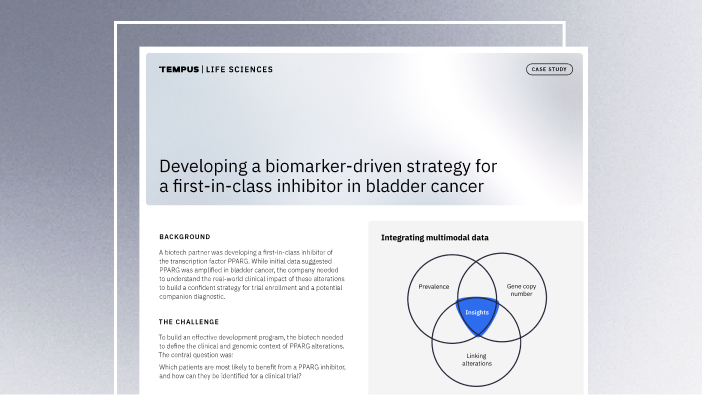
Biomarker strategy for an inhibitor in bladder cancer
Discover how Tempus’ multimodal data analysis helped a biotech partner identify a key biomarker in bladder cancer. This data-driven strategy de-risked clinical development and supported a successful $100 million financing round.
Read more -
 03/27/2026
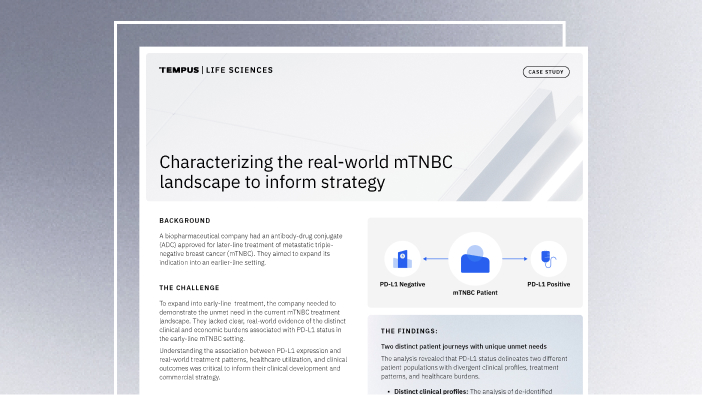
Characterizing the real-world mTNBC landscape to inform strategy
Learn how Tempus’ analysis of multimodal real-world data helped a biopharmaceutical company identify distinct patient journeys and healthcare burdens in mTNBC based on PD-L1 status, enabling them to refine their clinical and commercial strategy.
Read more -
 03/24/2026
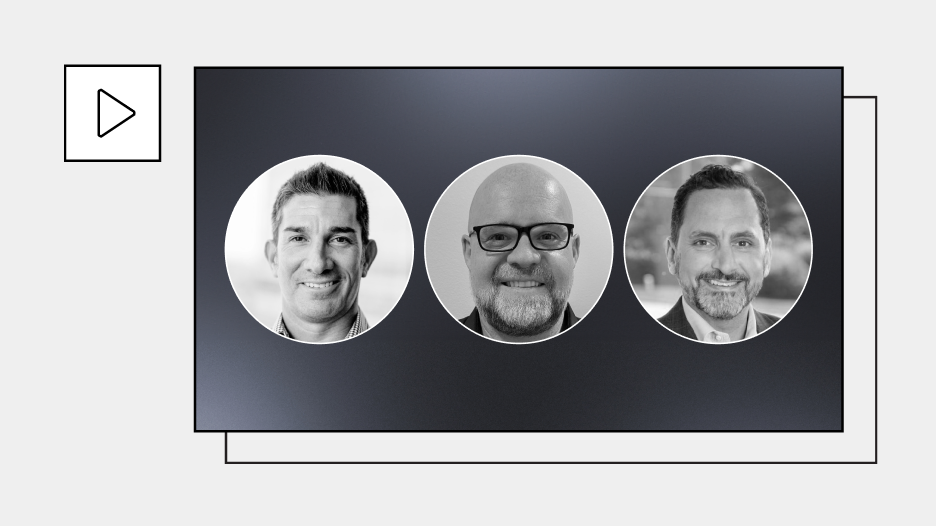
Translating data into an actionable R&D strategy
Hear from industry leaders about how a data-driven understanding of disease biology informs critical decisions and accelerates therapeutic development. Secure your recording now.
Watch replay