-
PROVIDERS
New MRD Medicare Coverage for Select Indications*
*When coverage criteria are met. Additional criteria and exceptions for coverage may apply.
-
LIFE SCIENCES
Register now
UPCOMING WEBINAR
Unlocking Foundation Models: Our experience from proof of concept to deploying at scale -
PATIENTS
It's About Time
View the Tempus vision.
- RESOURCES
-
ABOUT US
View Job Postings
We’re looking for people who can change the world.
- INVESTORS
12/18/2025
Q&A: How TechBio and multimodal data are reshaping R&D
In a recent webinar, leaders from Tempus and Recursion gathered to discuss how their partnership is leveraging AI and massive datasets to accelerate drug discovery and build a new paradigm for precision medicine.
Authors
Sid Jain,
SVP of Clinical Development & Data Science, Recursion

Hayley Donnella, PhD
VP of Frontier Research, Recursion

Shane Woods, PhD
Chief Strategy Officer, Tempus
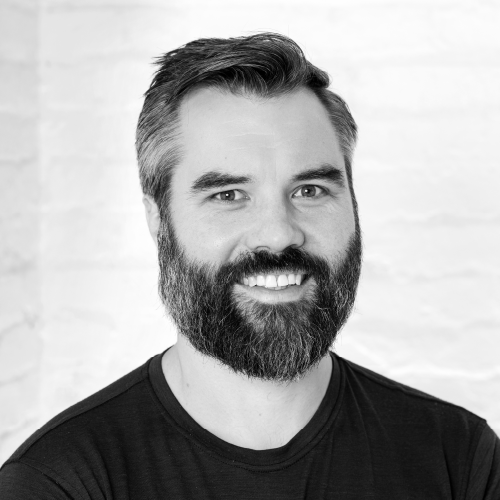
SVP of Clinical Development & Data Science, Recursion
Hayley Donnella, PhD
VP of Frontier Research, Recursion
Shane Woods, PhD
Chief Strategy Officer, Tempus
The panel featured Shane Woods, PhD, Chief Strategy Officer at Tempus, who was joined by two of Recursion’s scientific leaders: Sid Jain, who leads the company’s ClinTech platform, and Hayley Donnella, PhD, who heads Frontier Research. They provided an inside look at how their strategic partnership is moving beyond traditional R&D to build a faster, more efficient, and patient-centric future for the life sciences industry.
Shane Woods, PhD: The term “TechBio” is gaining significant traction. Could you unpack what this philosophy means for drug development and how it represents a fundamental shift from traditional R&D? |
Hayley Donnella, PhD: Traditional R&D often starts with a linear hypothesis: one target for one disease. You then spend years testing that single idea. We essentially flip that script. Instead of starting with a narrow hypothesis, we start with the data and ask, “Where do we see a signal?” This allows us to embrace biological complexity rather than reduce it. We generate massive amounts of fit-for-purpose data and then use modern AI tools to make sense of that complexity, building powerful maps of biology that turn discovery into a computationally searchable problem. We are not just bolting technology onto an existing pharma process. The tech is the process.
Sid Jain: While traditional R&D is reliable, it can be slow to change, often tacking new technology onto existing, sometimes broken, processes. The TechBio advantage is building from the ground up with data-first workflows that let us iterate at machine speed. This allows Recursion to move faster and find novel biology at scale. If you think of the traditional model as a single ship liner, our approach is more like a modern fleet with better instrumentation, allowing us to try multiple routes and course-correct very quickly. |
|
“By combining our experimental data with the large, multimodal patient data from Tempus… we get critical clinical grounding. This has already materially raised our confidence in our hypotheses.” – Sid Jain, SVP of Clinical Development & Data Science, Recursion |
Shane Woods, PhD: This partnership brings together an immense scale of data. Beyond the headline number, how does combining Tempus’ real-world patient data with Recursion’s experimental data unlock scientific programs that were previously out of reach? |
Hayley Donnella, PhD: The scale is significant, but what matters more is that the data is complementary and connected. Tempus provides the “forward genetics” view with rich, multimodal patient data, including genomics, transcriptomics, and clinical outcomes. This helps reflect the messy, human reality of disease. Recursion brings the “reverse genetics” complement, where we can precisely perturb biology, gene by gene, and measure how cells respond under controlled conditions.
Forward genetics alone gives you correlation, while reverse genetics provides functional clarity but lacks patient context. The magic happens when you fuse them. The patient data tells you what genes are associated with a disease, and our perturbational data tells you why. Layering these two views into our causal AI models allows us to finally move from correlation to causation. This helps us amplify signals that would normally require hundreds of thousands of patient samples to detect, which is a massive unlock for rare diseases and small patient cohorts. |
Shane Woods, PhD: Drug discovery faces undeniable challenges, from long timelines to high attrition rates. How are you applying this integrated TechBio approach in early research to tackle those core problems head-on? |
Hayley Donnella, PhD: The traditional R&D process often waits too long to ask, “Who is this drug for?” This creates a massive translational gap and leads to expensive, late-stage failures. We face those challenges head-on to de-risk our programs earlier. This happens in two key ways: acting on the right biology and acting on the right patient population.
By combining forward and reverse genetics, we can pursue novel biological targets with higher confidence because the insights are already grounded in patient data from day one. For patient populations, our causal AI models provide insights into not just causality, but also the context of where we should intervene. This has allowed us to identify novel expansion opportunities for preclinical programs and refine patient stratification by identifying clinically actionable subgroups and their associated biomarkers. We can kill bad ideas earlier and double down on the ones with a real shot at clinical relevance. |
|
“Our initial request was not typical. We did not ask for a dataset for one biomarker in one indication; we asked to stress-test Tempus’ entire universe of data for our causal modeling… Those conversations were productive, and the heavy lifting created the infrastructure that now supports everything from causal modeling to biomarker discovery.” – Hayley Donnella, PhD, VP of Frontier Research, Recursion |
Shane Woods, PhD: As programs advance from discovery into the clinic, the stakes get higher. How are you leveraging this data-driven approach to de-risk key clinical development decisions, such as validating patient selection strategies or refining biomarker hypotheses? |
Sid Jain: The signal from cell lines and animal models often doesn’t translate directly to the clinic. By combining our experimental data with the large, multimodal patient data from Tempus, which links treatments and outcomes, we get critical clinical grounding. This has already materially raised our confidence in our hypotheses.
We have used these integrated datasets to reprioritize indications for in-development assets, giving us more confidence in where to proceed and, just as importantly, where to stop. This is critical from both a probability of success and an ethical perspective. If we can better predict who will or will not respond, we can target trials to patients most likely to benefit. We have also used the data to refine inclusion and exclusion criteria in our protocols. For example, modifying a hemoglobin criterion can open the trial to a wider patient population, including minority groups that may have been excluded previously, increasing both the speed and the potential impact of the trial. |
Shane Woods, PhD: Integrating massive, diverse datasets from two different organizations sounds great in theory, but the reality is often complex. Could you share some of the key technical and organizational hurdles your teams had to overcome to make this partnership work effectively? |
Hayley Donnella, PhD: Our initial request was not typical. We did not ask for a dataset for one biomarker in one indication; we asked to stress-test Tempus’ entire universe of data for our causal modeling. This required a mindset shift on both sides. Before we could start, we had to align on what “good data” means when you are merging datasets built for different purposes—one for clinical interpretation and the other for machine learning. There was a lot of back and forth to align on data formats, schemas, and ontologies. Those conversations were productive, and the heavy lifting created the infrastructure that now supports everything from causal modeling to biomarker discovery.
Sid Jain: On the organizational side, culture is a true differentiator for Recursion. We have a nimble team that is willing to try new ideas at a speed that would be difficult in most other organizations. For example, we built a team and took an idea for our ClinTech approach from concept to use in 90 days. That culture of wanting to do things differently is a critical part of how we innovate. Any strong partnership goes through bumps, but we have always had the conviction that bringing our capabilities together would lead to amazing things. |
Shane Woods, PhD: In an industry where success is measured over a decade, demonstrating near-term impact is a major challenge. How does Recursion approach measuring the ROI of these new tools, and what leading indicators do you track to build confidence along the way? |
Sid Jain: We cannot shrink a 15-year drug development cycle to two years overnight, but we have clear leading indicators of ROI. These include prioritizing the right indications, starting clinical trials two to three months faster, and bending the enrollment curve by using a data-driven approach to site selection. Automating manual work is not just about cost savings; it allows us to pivot quickly when we see new signals in the data. Ultimately, the North Star remains getting new molecules into the hands of patients.
Hayley Donnella, PhD: We measure impact in two layers: scientific and operational. Scientifically, we look at our ability to recover known biological signals, which builds confidence in the novel insights our models generate. Operationally, we measure our “learning velocity”—how much validated insight we generate per cycle and how quickly that insight feeds back into the system. These small accelerations stack up and create a compounding advantage, teaching the system how to get better at discovery and translation for the next program. |
Shane Woods, PhD: Looking ahead, what is your vision for where the TechBio revolution will lead the industry, and what can organizations do today to prepare for that future? |
Hayley Donnella, PhD: We are finally collapsing the distance between discovery and the patient. We can now design programs with patient context baked in from day one. The next frontier is increasingly agentic and autonomous science, where AI helps us explore the full search space of biology with scientific rigor and at scale. This transformation is already starting to happen. The question is not if, but how we will do it responsibly, keeping patients at the center of everything we do.
Sid Jain: My vision is for precision medicine to become a reality, whether that eventually looks like an N-of-1 trial or not. We want to industrialize development in a way that we can simulate and predict response, run adaptive trials, and find the right patient cohorts before the first patient is even enrolled. That is what the future of precision medicine looks like. |
Please note that the content in this document has been revised for clarity and conciseness. Some language and formatting may have been adjusted to enhance readability while preserving the original meaning and intent of the discussion.
| To gain comprehensive insights into Tempus’ role in advancing precision medicine, we invite you to watch the webinar recording. For in-depth demonstrations of our AI-enabled applications, contact us here. |
-
 04/03/2026
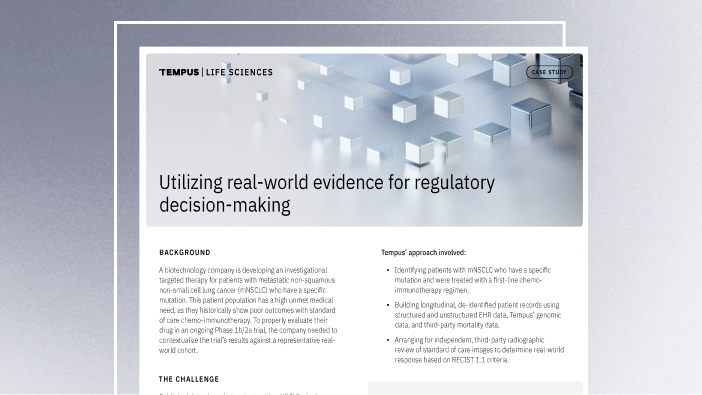
Utilizing real-world external controls for regulatory decision-making
A biotech company needed to contextualize its Phase 1b/2a trial for mNSCLC patients with a specific mutation. Learn how Tempus constructed a real-world external control arm to provide a benchmark for their regulatory submission.
Read more -
 03/30/2026
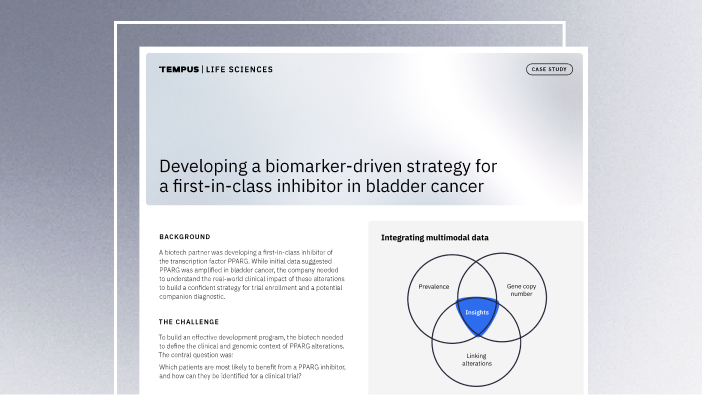
Biomarker strategy for an inhibitor in bladder cancer
Discover how Tempus’ multimodal data analysis helped a biotech partner identify a key biomarker in bladder cancer. This data-driven strategy de-risked clinical development and supported a successful $100 million financing round.
Read more -
 03/27/2026
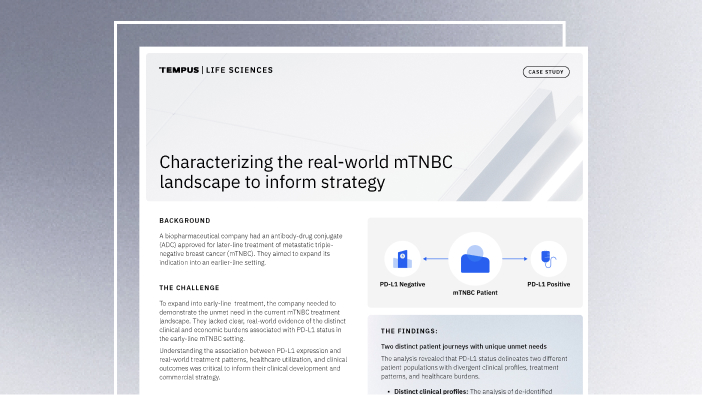
Characterizing the real-world mTNBC landscape to inform strategy
Learn how Tempus’ analysis of multimodal real-world data helped a biopharmaceutical company identify distinct patient journeys and healthcare burdens in mTNBC based on PD-L1 status, enabling them to refine their clinical and commercial strategy.
Read more