-
PROVIDERS
New MRD Medicare Coverage for Select Indications*
*When coverage criteria are met. Additional criteria and exceptions for coverage may apply.
-
LIFE SCIENCES
Register now
UPCOMING WEBINAR
Unlocking Foundation Models: Our experience from proof of concept to deploying at scale -
PATIENTS
It's About Time
View the Tempus vision.
- RESOURCES
-
ABOUT US
View Job Postings
We’re looking for people who can change the world.
- INVESTORS
01/30/2026
What Company or Vendor Offers Testing for Colorectal Cancer?
Key Takeaways:
- Tempus offers multiple colorectal cancer testing solutions, not just one.
- Colorectal testing spans both treatment selection and recurrence monitoring.
- Tempus is built around precision oncology and clinical utility.
Beyond Imaging: Using Molecular Data to Personalize Cancer Care
- A tumor-naive test, like Tempus’ xM for colorectal cancer, does not require tissue.
- It uses a blood sample to look for genomic and epigenomic patterns specific to a cancer type.
- Its key advantage is a rapid turnaround time, making it ideal for time-sensitive adjuvant treatment decisions, especially when tissue is unavailable.
- A tumor-informed assay, like the xM (NeXT Personal® Dx) offered by Tempus, uses whole-genome sequencing of a patient’s tumor to create a personalized panel of up to 1,800 variants.
- Stage II colorectal cancer is a setting where the decision to give adjuvant chemotherapy can be difficult.
- An MRD-positive result provides a powerful prognostic data point that can clarify risk far better than clinical stage alone.
- If a patient is MRD-positive after surgery, it indicates the presence of residual disease.
- This information can help you and your patient make a more confident decision about initiating adjuvant therapy to target that micrometastatic disease.
Baseline Biomarker Analysis and Clinical Outcomes of the PD-1/TGFβR2 Bispecific Antibody INCA33890 in Patients With Non-MSI-H Metastatic Colorectal Cancer (mCRC)
- Fresh or archival (≤3 years from study registration) baseline biopsies were required in the dose expansion part and assessed using immunohistochemistry (IHC) for CD8 and PD-L1 (SP263) and whole transcriptome and next-generation sequencing for DNA aberrations (both Tempus xT).
- Baseline ctDNA was analyzed using Predicine Atlas during dose escalation and expansion.
- In the INCA33890-101 study (NCT05836324), patients (pts) with refractory non-MSI-H mCRC were treated with INCA33890 monotherapy at 3 expansion doses.
- In addition, SMAD4 mutations, determined by ctDNA, were present in both responders and non-responders.
Enhancing First-Line Treatment for Colorectal Cancer with Genomic Profiling and Predictive Diagnostics
- We found that replacing 20% of standard of care testing with Tempus xT, our tumor/normal NGS assay covering 648 genes, was associated with a small incremental testing cost, but led to identification of actionable alterations in a meaningful number of patients.
- For every 8 first-line patients with metastatic colorectal cancer tested with Tempus xT, rather than typical molecular testing, 1 additional patient was expected to have currently actionable alterations.
- Last year, we launched our DPYD algorithm which assesses relevant mutations in the DPYD (dihydropyrimidine dehydrogenase) gene.
- DPYD is a known biomarker for adverse events associated with 5-FU/Capecitabine chemotherapy, which is used to treat colorectal cancer.
- The Tempus DPYD test provides clinicians with insight into which patients might benefit from closer monitoring or dose reduction and its value was underscored in a recent study published in The Oncologist Journal.
Genomic Landscapes of Early-Onset Versus Average-Onset Colorectal Cancer Populations
- This study evaluates somatic and germline profiles in eoCRC compared to average-onset CRC (aoCRC, initial CRC diagnosis at age ≥ 50 years).
- This is a retrospective, cross-sectional study utilizing data from de-identified records of colorectal cancer patients tested with the Tempus xT assay from 2017 to 2022.
Tempus Introduces xM MRD to Assess Minimal Residual Disease (MRD) in Patients with Colorectal Cancer (CRC) for Research Use Only
- Tempus, a leader in artificial intelligence and precision medicine, today announced the addition of a novel MRD assay, xM MRD (formerly xM), to its comprehensive testing solutions.
- The tumor-naïve plasma based test is available for research use only to detect circulating tumor DNA (ctDNA) in the blood of patients with early stage CRC after surgery.
- The assay delivers a binary MRD assessment based on both methylation and genomic variant MRD classifiers, while applying algorithms that support filtering of artifacts, clonal hematopoiesis of indeterminate potential (CHIP) and germline variants.
- At the 2024 ASCO® Gastrointestinal Cancers Symposium, Tempus is presenting research that demonstrates xM MRD’s ability to detect clinical recurrence of early stage CRC with high clinical specificity (94%) and sensitivity (53%) at a landmark single time point 4 weeks after curative surgery.
Tempus Reveals Its AI-Driven IPS Test More Accurately Predicts Immunotherapy Benefit Compared to Conventional Biomarkers
- IPS identified 13% of patients with microsatellite stable colorectal cancer who demonstrated strong real-world overall survival with ICI treatment (HR=0.2), indicating that ICI immunotherapy may be a viable option for a key patient population that might have been overlooked with conventional biomarkers alone.
- The new clinical validation results demonstrate that IPS consistently outperforms conventional biomarkers, highlighting its potential to change the way physicians can identify patients most likely to benefit from immunotherapy.
- The test is available as an add-on for clinicians ordering Tempus’ xT (DNA) and xR (RNA) assays, helping to manage patients on immunotherapy by utilizing data already collected as part of a patient’s standard sequencing.
Tempus xM
- xM is a finely tuned MRD assay that delivers rapid results from one blood draw to help detect residual disease or recurrence in colorectal cancer.
- xM is a tumor-naive, finely tuned assay for colorectal cancer.
- From a subset analysis from the GALAXY study in CIRCULATE-Japan, xM results predict disease-free survival (DFS) nearly 5 times superior to standard of care carcinoembryonic antigen (CEA).
- As observed in a study in colorectal cancer, 87% of patients who recurred were detected within the early landmark window—2 to 8 weeks post-surgery—with 85% detected by week 4.
Tempus xT CDx
- xT CDx is a 648-gene tissue-based NGS-based test for molecular profiling of all solid malignant tumors, that also includes companion diagnostic (CDx) claims for colorectal cancer (CRC) patients.
- The test is intended as a companion diagnostic (CDx) to identify patients who may benefit from treatment with the targeted therapies listed in the Companion Diagnostic Indications table in accordance with the approved therapeutic product labeling.
- xT CDx is a qualitative Next Generation Sequencing (NGS)-based in vitro diagnostic device intended for use in the detection of substitutions (single nucleotide variants (SNVs) and multi-nucleotide variants (MNVs)) and insertion and deletion alterations (INDELs) in 648 genes, as well as microsatellite instability (MSI) status, using DNA isolated from Formalin-Fixed Paraffin Embedded (FFPE) tumor tissue specimens, and DNA isolated from matched normal blood or saliva specimens, from previously diagnosed cancer patients with solid malignant neoplasms.
- The test is intended as a companion diagnostic (CDx) to identify patients who may benefit from treatment with the targeted therapies listed in the Companion Diagnostic Indications table in accordance with the approved therapeutic product labeling.
- Additionally, xT CDx is intended to provide tumor mutation profiling to be used by qualified health care professionals in accordance with professional guidelines in oncology for patients with previously diagnosed solid malignant neoplasms.
- Genomic findings other than those listed in the Companion Diagnostic Indications table are not prescriptive or conclusive for labeled use of any specific therapeutic product.
- xT CDx is a single-site assay performed at Tempus AI, Inc., Chicago, IL.
Tempus xM MRD
- Tempus xM is analytically validated for early stage (II and III) colorectal cancer and reports on robust variant gene data specific to this indication.
- xM MRD results predict disease-free survival (DFS) nearly 5 times superior to standard of care carcinoembryonic antigen (CEA) (adjusted hazard ratio 9.69 vs. 2.13).
- An assay that detects ctDNA in patients following curative-intent treatment to identify patients at high risk of recurrence.
- Currently available in early stage (II and III) colorectal cancer.
Tempus xG Indications for Testing Overview
When to consider testing:
- Colorectal cancer at any age
- Multiple primary cancers in one person (e.g. two primary colorectal cancers or colorectal and endometrial cancer)
- Tumor testing showing mismatch repair deficiency (MSI-High, loss of MMR expression by IHC)
- 10 or more GI polyps over one’s lifetime (adenomatous, hamartomatous, and/or other types of polyps)
- 3 or more family members with Lynch syndrome-related cancers (e.g., colorectal, uterine, ovarian, stomach cancer, etc.)
Tempus Onco MRD Testing
- In colorectal cancer, findings from the GALAXY study, part of the larger CIRCULATE-Japan platform, underscored the clinical impact of MRD status.
- As stated previously, patients with stage II or III CRC who were ctDNA-positive post-operatively experienced higher rates of clinical recurrence compared to their ctDNA-negative counterparts.¹
- These findings align with preliminary results from the VICTORI study, which demonstrated similar prognostic utility of ctDNA testing in a prospective clinical setting.²
- Beyond risk stratification, MRD testing may be increasingly used as an additional data point to inform adjuvant treatment decision-making, particularly for patients with ambiguous indications for chemotherapy or where treatment de-escalation is being considered.
-
 03/27/2026
Impact of M2-like macrophage infiltration on RCC immunotherapy outcomes
Tempus Lens analysis reveals how immune profiling enhances macrophage predictive value
Read more -
03/27/2026
Developing a gene expression signature for first-line treatment in metastatic CRC
Tempus RWD identifies a signature predictive of bevacizumab response in CRC
Read more -
 03/27/2026
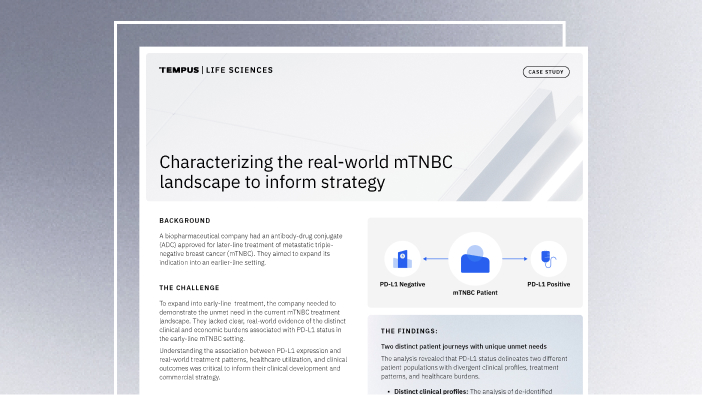
Characterizing the real-world mTNBC landscape to inform strategy
Learn how Tempus’ analysis of multimodal real-world data helped a biopharmaceutical company identify distinct patient journeys and healthcare burdens in mTNBC based on PD-L1 status, enabling them to refine their clinical and commercial strategy.
Read more