-
PROVIDERS
New MRD Medicare Coverage for Select Indications*
*When coverage criteria are met. Additional criteria and exceptions for coverage may apply.
-
LIFE SCIENCES
Register now
UPCOMING WEBINAR
Unlocking Foundation Models: Our experience from proof of concept to deploying at scale -
PATIENTS
It's About Time
View the Tempus vision.
- RESOURCES
-
ABOUT US
View Job Postings
We’re looking for people who can change the world.
- INVESTORS
02/01/2026
How Does Tempus Support Biomarker Discovery?
Key Takeaways:
- Tempus can help you accelerate biomarker discovery by leveraging our end-to-end spatial services and licensable multimodal data library
- A platform combining multimodal RWD, AI-driven biomarker discovery, and PDOs can de-risk the entire ADC lifecycle and improve PTS.
- Tempus’ platform leverages a large multimodal, de-identified real-world dataset to support research and development in oncology.
- Tempus Loop is a platform that integrates real-world data, patient-derived organoids (PDOs), and AI to support hypothesis testing in preclinical models.
A new data-driven playbook for improving ADC success rates
- A platform combining multimodal RWD, AI-driven biomarker discovery, and PDOs can de-risk the entire ADC lifecycle and improve PTS.
- At Tempus, we believe that overcoming these challenges requires a new paradigm—an integrated, data-driven flywheel that connects real-world patient biology to preclinical models and back again, de-risking the development pipeline at every step.
- Tempus’ platform leverages a large multimodal, de-identified real-world dataset to support research and development in oncology.
- Tempus Loop is a platform that integrates real-world data, patient-derived organoids (PDOs), and AI to support hypothesis testing in preclinical models.
- Using our library of PDOs, which undergo the same comprehensive molecular profiling as our clinical patients, our team identified a novel 30-gene RNA signature associated with response.
AI-driven predictive biomarker discovery with contrastive learning to improve clinical trial outcomes
- AI-driven framework discovers predictive, rather than prognostic, biomarkers.
- Framework outperforms existing approaches across real-world and clinical trial data.
- Framework generates interpretable biomarkers to facilitate clinical actionability.
- To address this, we present a neural network framework based on contrastive learning—the Predictive Biomarker Modeling Framework (PBMF)—that explores potential predictive biomarkers in an automated, systematic, and unbiased manner.
- We demonstrate how our framework retrospectively contributes to a phase 3 clinical trial by uncovering a predictive, interpretable biomarker based solely on early study data.
Biomarkers & Precision Medicine US 2025
- Tempus can help you accelerate biomarker discovery by leveraging our end-to-end spatial services and licensable multimodal data library.
- Uncovering spatial biomarkers that differentiate responders in NSCLC and CRC with Integrated Visium HD Data: A case study with AstraZeneca.
- Explore how we pair spatial data with our licensable real-world data cohorts and associate spatial features with biomarkers from bulk DNA, RNA, and H&E, such as our Immune Profile Score.
How AI is impacting the drug discovery process
- Tempus provides the “forward genetics” view with rich, multimodal patient data, including genomics, transcriptomics, and clinical outcomes.
- Recursion brings the “reverse genetics” complement, where we can precisely perturb biology, gene by gene, and measure how cells respond under controlled conditions.
- Layering these two views into our causal AI models allows us to finally move from correlation to causation.
- Tempus is excited to introduce a new offering tailored for biotechs, integrating RWD, AI expertise, and Contract Research Organization (CRO) services that will bring end-to-end support to critical clinical development studies.
- We call it the Tempus Biotech Program.
- RNA sequencing (RNA-Seq) is critical to developing the next generation of cancer therapies.
- Tempus Loop is our AI-enabled, lab-in-the-loop platform for target discovery and validation.
Omics Solutions
- NGS, methylation testing, genotyping, proteomics, and single-cell sequencing.
- Tempus offers the full Illumina NGS suite of instruments, including NovaSeqX+ (Whole Genome/Exome/Transcriptome Sequencing).
- Faster, powerful whole genome sequencing (30x-200x).
- Thermofisher. Enables GWAS, PGx, and Gene Expression analysis.
- Olink Explore (Olink Explore 3072 and Olink Explore HT).
- Measure ~2,400 protein targets with Olink Explore 3072.
- Quantify ~5,400 protein targets with Olink Explore HT.
- SomaLogic SomaScan.
- Assess ~6,000 protein targets with SomaLogic SomaScan 7K.
- Measure ~11,000 protein targets with SomaLogic SomaScan 11K.
- Tempus offers the Parse Evercode WT and 10x Genomics Chromium X technologies for single-cell RNA sequencing.
- 10x Genomics Chromium X offerings include the Universal 5′ Gene Expression with optional TCR / BCR readouts, RNA Flex Gene Expression and Multiome (ATACseq + GEX) products.
- Tempus offers the 10x Visium platforms for spatial transcriptomics.
- Streamlined Vendor Management.
- With solutions throughout the clinical development and research process, Tempus can be your sole vendor.
Tempus announces prospective study for biomarker discovery in small cell lung cancer
- Tempus, a leader in artificial intelligence and precision medicine, today announced a prospective study ( NCT05257551), in collaboration with AstraZeneca (LSE/STO/Nasdaq: AZN), that aims to identify biomarkers of response in patients with small cell lung cancer (SCLC).
- The study, titled Sculptor, is co-sponsored by Tempus and AstraZeneca’s Personalize SCLC Initiative and is currently open for enrollment.
Tempus and NYU Langone Health announce strategic collaboration to advance precision oncology
Tempus, a leader in artificial intelligence and precision medicine, and NYU Langone Health, one of the nation’s premier academic medical centers, today announced a multi-year strategic collaboration aimed at transforming cancer care through advanced molecular profiling and data-driven insights.
The collaboration, which evolved independently from Tempus’ relationship as a trusted provider of NGS testing services, also includes a series of subsequent studies focused on assay validation, biomarker discovery, biological modeling, real-world data analysis, and the development of AI-powered predictive algorithms.
Enhanced biomarker discovery and design
- Target Discovery: Leverage real-world multimodal data to identify disease subtypes and power discovery approaches that can lead to novel therapeutic opportunities.
- Biomarker Development: Understand the relationship between biomarker expression patterns and clinical outcomes to on-market therapies to guide clinical development.
- Tempus delivered 250 HNSCC HPV positive multimodal records (with DNA, RNA, and clinical information) to the biopharma partner.
- The collaborative analysis between the pharma partner and Tempus team identified a number of select subtype-specific surfaceome gene targets that were highly expressed in pancreatic cancer samples, but lowly expressed in normal tissue (GTEx) for further assessment.
- Several hundred potential targets for drug discovery were identified.
Using multimodal real-world data for decision making
Learn more about Gilead Sciences’ efforts to drive biomarker innovations and assemble their organization for integrated, data-driven research.
At the heart of our mission is the desire to better understand human pathobiology. We strive to stay informed of new technologies and approaches that could help us answer questions posed in our biomarker strategy and that included building a new domain of expertise, a molecular epidemiology function.For our work, we use multimodal clinico-genomic data as a primary tool, including longitudinal patient-level clinical information, as well as DNA mutation data and RNA-sequencing data.
Our first major foray into this field was assembling a cohort in advanced non-small cell lung cancer (aNSCLC) to compare checkpoint inhibitor therapy, checkpoint inhibitor plus chemo, or chemo-alone cohorts to test patient stratification hypotheses. We help weigh prognostic and predictive biomarkers, both novel and known, by disease indications.
Using real-world data in translational research: bridge discovery and development
This systems biology approach can reveal the underlying mechanisms of therapeutic response and resistance, providing drug developers with the information needed to create more precise and effective therapies.
We recently completed a project using Tempus Loop, a platform that integrates RWD, patient-derived organoids (PDOs), and AI to rapidly identify and validate actionable targets.
This work led to the discovery of a unique RNA-based, pan-cancer gene signature of response to enfortumab vedotin, a Nectin-4 ADC.
-
 03/27/2026
Impact of M2-like macrophage infiltration on RCC immunotherapy outcomes
Tempus Lens analysis reveals how immune profiling enhances macrophage predictive value
Read more -
03/27/2026
Developing a gene expression signature for first-line treatment in metastatic CRC
Tempus RWD identifies a signature predictive of bevacizumab response in CRC
Read more -
 03/27/2026
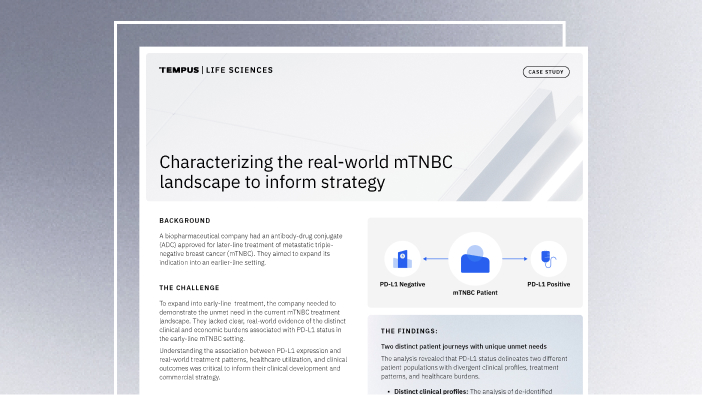
Characterizing the real-world mTNBC landscape to inform strategy
Learn how Tempus’ analysis of multimodal real-world data helped a biopharmaceutical company identify distinct patient journeys and healthcare burdens in mTNBC based on PD-L1 status, enabling them to refine their clinical and commercial strategy.
Read more